
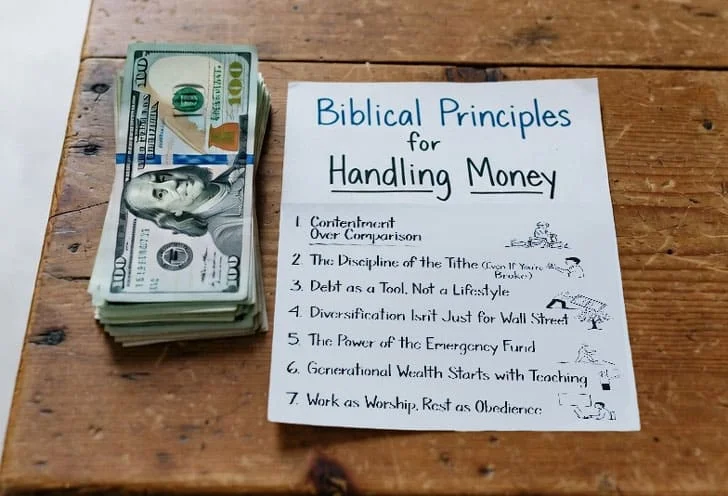
I was sitting at our kitchen table last month, staring at the June statement, when my husband said something I’ll never forget: “You look at money like it’s a puzzle with missing pieces.” He wasn’t wrong. For years I thought financial peace meant having all the right apps and accounts. It doesn’t.
It means following some really old rules that most people have forgotten about. Not prosperity-gospel shortcuts or get-rich-quick schemes — practical guidelines that generations of families used to build wealth without drama.
{{image:cover.webp}}
1. Contentment Over Comparison
Social media in 2025 is designed to make you feel behind. One scroll through luxury travel posts or “day in the life of a tech bro” reels and suddenly you’re adding items to your cart that your budget didn’t plan for.
Here’s what I do: I track my comparison triggers. I use YNAB or Mint to set spending limits in categories where lifestyle creep sneaks in — dining out, clothes, gadgets. A study from the Journal of Consumer Research found that practicing gratitude can reduce spending by up to 25%. So every week I do a quick contentment audit: three things I’m grateful for before I even open my banking app.
2. Pay First (Even When You’re Tight)
Setting aside 10% of your income feels impossible when rent alone eats 40%. But the principle isn’t about hitting a specific percentage — it’s about what you prioritize first.
I started with something I call the “reverse approach”: live on 90% and automate 10% out before bills arrive. You can use micro-giving platforms like RoundUp apps — for example, Acorns’ charity feature lets you donate spare change automatically. Research from the National Study of American Religious Giving shows that consistent givers report higher financial peace, even at lower income levels. The amount matters less than the habit.
3. Debt as a Tool, Not a Lifestyle
The old saying goes: “The borrower is slave to the lender.” In 2025, services like Affirm and Klarna have normalized debt for $50 dinner orders. The average American now carries $6,500 in credit card debt, according to the Federal Reserve’s 2024 data.
Treat debt like fire — useful when controlled, destructive when it spreads. I use what I call the Debt Snowball Plus method:
- List your debts from smallest balance to largest.
- Pay minimums on everything except the smallest one.
- Throw every extra dollar at that smallest debt — tax refunds, side hustle income, whatever you can find.
- Roll those payments forward as each debt disappears.
My literal pro tip: freeze one credit card in a block of ice. It sounds silly until you’ve tried to pull it out at 10 p.m. on a Tuesday.
4. Diversification Isn’t Just for Wall Street
“Divide your portion to seven, or even to eight, for you do not know what misfortune may occur.” Written in an agrarian economy, that line is the original pitch for diversification.
Don’t put all your eggs in one asset class. A balanced 2025 portfolio might look like this:
- 40% Index Funds — VTSAX or target-date funds (a basket of stocks that reinvests automatically)
- 20% Real Estate — REITs through Vanguard or crowdfunded platforms like Fundrise
- 15% Emergency Cash — high-yield savings earning 4.5%+ APY
- 10% Side Hustle Income — Etsy, Uber, or AI content tools
- 15% Speculative — crypto or individual stocks, only what you can afford to lose
Rebalance once a year. I use the free tool Portfolio Visualizer to stress-test my mix.
{{image:image-01.jpg}}
5. The Emergency Fund (Your Financial Airbag)
Job loss, a medical emergency, or a $1,200 car repair can wipe out years of progress without a buffer. I learned this the hard way.
Aim for 3 to 6 months of essential expenses in a separate high-yield savings account — Ally or Capital One 360 both work well. Start small if you have to:
Name the account something that motivates you. I called mine “Peace of Mind Fund.” Every time I logged in, it reminded me why I was saving.
6. Generational Wealth Starts with Teaching
Financial literacy isn’t taught in 87% of U.S. high schools, according to the Council for Economic Education’s 2024 report. That means parents like us have to fill the gap.
I turn allowance into a mini-economy:
- 50% Save — you can even open a Roth IRA for kids who earn income from chores (yes, really)
- 30% Spend — teaches budgeting through real choices
- 20% Give — builds generosity before it becomes abstract
Apps like Greenlight or GoHenry make this manageable with parental controls and real-time tracking.
7. Work as Purpose, Rest as Discipline
Hustle culture treats 80-hour weeks like a badge of honor. But burnout costs U.S. companies $190 billion annually, according to Gallup.
I implemented what I call the “Sabbath Budget”: six days on (focused work, side hustles, skill-building) and one day off — no transactions, no financial apps, no quick Amazon orders. Research from the Journal of Happiness Studies found that people who keep a weekly rest day report 23% higher life satisfaction.
Your 30-Day Money Action Plan
Here’s how I’d start these principles this week:
- Contentment: Delete shopping apps. Write one gratitude note each day.
- Paying First: Automate 1% giving, then increase by 1% each month until you hit your target.
- Debt: Freeze one credit card and pay $50 extra on your smallest debt this month.
- Diversification: Open a Vanguard account and invest $100 in VTSAX to start.
- Emergency Fund: Transfer $25 a week to a high-yield savings account. Set it up once, then forget it.
- Teaching Kids: Set up a three-jar system at home — Save, Spend, Give.
- Sabbath Budget: Pick one day this week to be completely screen-free and transaction-free.
A Final Thought
No amount of financial planning promises a Lamborghini in the garage. It promises peace at the kitchen table. In 2025, that might look like a paid-off car, a growing Roth IRA, and the freedom to say “no” to overtime you don’t need.
Which principle will you start with this week? Pick one. Start small. Financial freedom is built one decision at a time.
Disclosure: This article contains affiliate links to financial tools mentioned. I only recommend products I use myself or have thoroughly researched.