

My husband once asked me, while we were splitting the monthly business statement over the kitchen table, “why does this card earn more than your salary?” It was a small business credit card. The one in question is the Chase Ink Business Premier Card, and it’s the one card in Chase’s small business lineup that’s built for people who would rather have cash back than points.
It costs $195 a year. In exchange, you earn 2.5% cash back on any single purchase of $5,000 or more, 2% on everything else, 5% on travel booked through the Chase Travel portal, and a $1,000 welcome bonus after $10,000 in spending in the first three months. If your business makes big purchases regularly, the fee pays for itself faster than you might think.

The basics: what the Ink Business Premier actually offers
Most business cards are points machines. This one isn’t. The rewards here are plain cash back, and you can’t convert them into Chase Ultimate Rewards points to transfer to airlines and hotels. If that’s a dealbreaker for you, the other Ink cards are worth a look. If you just want money back in your account, this is the card to understand.
- $195 annual fee, no extra cost to add authorized users
- $1,000 welcome bonus after $10,000 in spending within the first three months
- 5% cash back on travel purchased through the Chase Travel portal
- 2.5% cash back on any purchase of $5,000 or more
- 2% cash back on all other purchases, with no foreign transaction fees
The welcome bonus works even if you already hold another Chase Ink card, which is unusual. Chase’s standard application rules still apply, and the 5/24 rule technically exists, though in practice it’s not enforced as consistently as it used to be.
The $1,000 bonus: how the welcome offer actually plays out
Here’s the math I’d want to see before applying. You need to put $10,000 on the card in your first three months to unlock $1,000 in cash back. That’s about $3,333 a month, or roughly $778 a week. For a business that buys supplies, equipment, or services in bulk, that’s a normal quarter, not a sprint.
The bonus is real money, not points you have to redeem through a portal. It lands as cash back, same as every other reward on this card. There’s no minimum redemption amount, so you can pull it out whenever you want.
The $195 fee: when it stops being expensive
A $195 annual fee is on the higher end for a business card, and the first thing I do with any fee is figure out the break-even. Here’s the version I’d actually run.
Suppose the alternative is a card with no annual fee that earns 2% flat. On purchases under $5,000, both cards earn the same rate, so the fee is just a cost. The difference appears on big purchases: you earn an extra 0.5% on everything $5,000 and up.
Divide the $195 fee by that 0.5% and you get $39,000. Spend $39,000 on purchases of $5,000 or more in a year and the incremental rewards cover the fee exactly. Spend more and the card is net positive. For a business that buys in volume, $39,000 in large transactions is a realistic number, not a stretch.
The card also carries no foreign transaction fees, which matters if any of your purchasing crosses borders.

Redeeming rewards: why cash is the point here
There are four ways to get your cash back out. Statement credit, applied to your card balance, or a direct deposit into a checking or savings account. You can also redeem for gift cards, travel, or retail purchases, but you don’t get outsized value doing it that way. $1,000 in rewards is $1,000 worth of travel or gift cards, full stop.
My take: redeem to your bank account. Cash back from spending generally isn’t taxed the same way income is, but that’s worth confirming with your own accountant. Once it’s in your account, it’s just money. Use it for the next round of supplies, or pay down the card balance, or split it into your emergency fund. The flexibility is the whole point of a cash back card.
One more thing to know: because these rewards can’t be transferred to Chase airline and hotel partners, this card is not a travel rewards play. It’s a cash play. If your business travels a lot and you’d rather bank points, the other Ink cards make more sense.
Protections worth knowing about
Beyond the rewards, the card bundles in a set of protections that would cost real money if you bought them separately:
- Rental car collision damage waiver (CDW) coverage
- Trip cancellation and trip interruption insurance
- Travel and emergency assistance services
- Purchase protection
- Cell phone protection
- Extended warranty protection
The rental car coverage, cell phone protection, and purchase protection are the three I’d actually use. The cardmember agreement has the full details, so it’s worth a skim before you rely on any of it.

How it stacks up against the other Ink cards
The Ink Business Premier is one of four cards in the Chase Ink Business lineup. Here’s the shape of the rest of the family, in case you’re trying to decide where this fits.
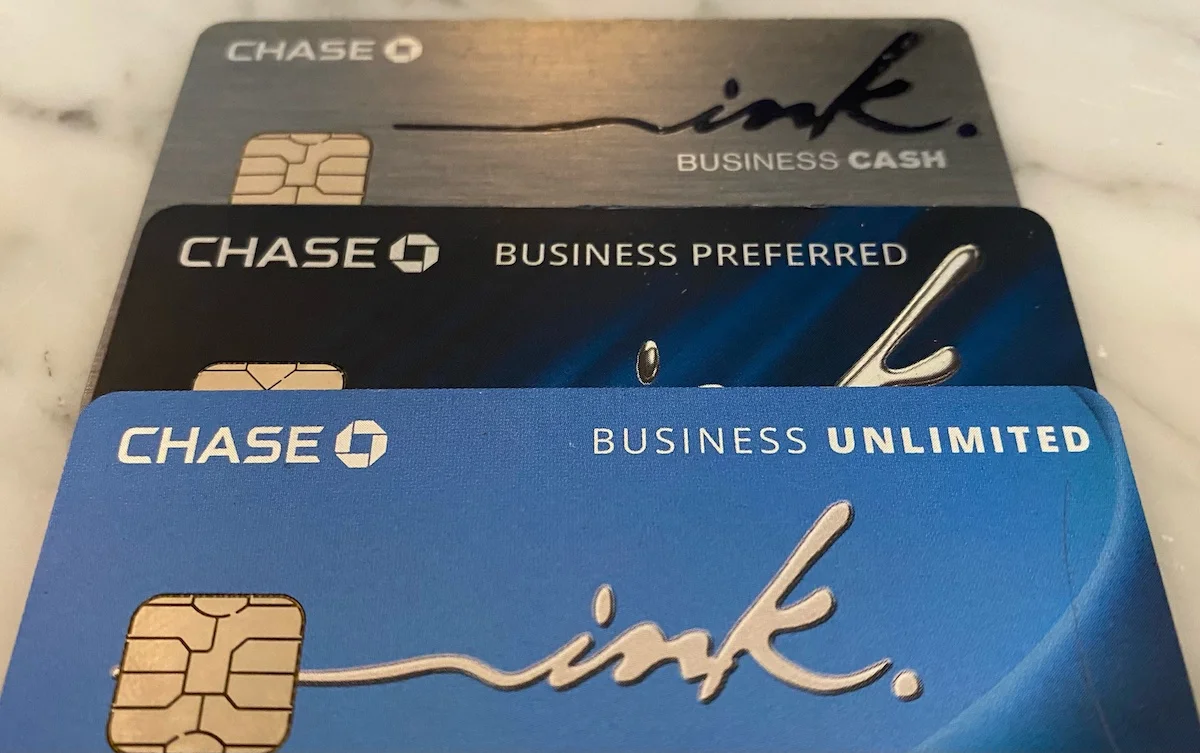
The Ink Business Preferred Card has a $95 annual fee and earns 3x points on the first $150,000 of combined purchases each account anniversary year across travel, shipping, internet, cable, phone, and advertising with social media and search engines.
The Ink Business Cash Card has no annual fee and earns 5x points on the first $25,000 of combined purchases each anniversary year on office supply stores, internet, cable TV, mobile phones, and landlines, plus 2x points on the first $25,000 on restaurants and gas stations.
The Ink Business Unlimited Card has no annual fee and earns 1.5x points on all business purchases.
If you want travel rewards, a combination of the Preferred and either the Cash or Unlimited card makes a lot of sense. If you want cash back, the Premier is the stronger pick, especially for large purchases.
Ink Business Premier versus the Capital One Spark Cash Plus
The closest competitor I’d compare this card to is the Capital One Spark Cash Plus. It earns a flat 2% on all purchases with no foreign transaction fees, and if you put $150,000 a year on the card, Capital One refunds the annual fee every year.
The key difference: Spark Cash Plus rewards can be converted into travel rewards when paired with another Capital One travel card. The Premier’s cash back can’t. If your business regularly makes purchases over $5,000 and you don’t care about points, the Premier is the stronger fit. If your spending is spread across many smaller transactions, the Spark Cash Plus is probably the better bet.
Is it worth the $195 fee? My honest take
Quick disclaimer: this is my analysis, not professional financial advice. Run the numbers against your own spending before you apply, and check the card’s current terms on Chase’s site, since offers change.
For a business that makes large purchases and wants plain cash back, this card is close to a no-brainer. 2.5% on $5,000-plus transactions is a rate I haven’t seen on another business card with no spending caps, and the $39,000 break-even is reachable for most businesses that buy in volume. The $1,000 welcome bonus sweetens a first year that should already be profitable.
For a business that makes mostly small purchases, or that would rather bank transferable points, the other Ink cards or the Spark Cash Plus will serve you better. The fee is only worth it if the big-purchase rate actually gets used.
If you’re on the fence, here’s the one thing I’d do today: pull your last three months of business card statements and add up every single transaction over $5,000. Multiply that total by 2.5% and compare it to the same total at 2%. The difference is what the card is really worth to you. If that number clears $195, the fee earns its keep.
Slow and steady still applies to business cards. Pick the one that matches how your business actually spends, and the math will take care of itself.