
My husband once told me I look at our retirement accounts the way most people look at celebrity posters on a wall — acknowledged, but never really examined. Tax season is when I finally pull down those posters and see what’s behind them.
I used to dread filing taxes more than anything. Then I realized tax season is actually a chance to reflect on how far we’ve come financially, hunt for deductions I didn’t know existed, and make moves that put money back in our pocket before the year closes.
Today I want to walk through three strategies for lowering your 2024 tax bill — plus some of those confusing forms you might encounter along the way. These are all U.S.-specific (IRS rules), so if you’re reading this from outside the United States, treat the numbers as a reference point rather than a prescription.
One thing they share: contributions made in 2025 can be designated for the 2024 tax year. When your brokerage asks which contribution year to select, choose 2024 if you want this year’s filing to benefit.
The Traditional IRA
If neither you nor your spouse has an employer-sponsored retirement plan at work — meaning no 401(k) or 403(b) — each of you can contribute up to $7,000 to a Traditional IRA for the 2024 tax year.
That’s $14,000 you can wipe off the top of your taxable income if both partners max out. Keep in mind these are individual accounts — there is no such thing as a joint IRA.
Here’s how to think about the savings. If you and your spouse sit in the 24% marginal tax bracket after other deductions, contributing $14,000 means roughly $3,360 in tax savings ($14,000 × 24%). That single move could eliminate a $1,500 tax bill and generate a refund on top.
But your income might block the deduction. The IRS sets phaseout ranges based on whether you’re covered by a workplace plan:
- Covered by a workplace plan — single filer: Deduction phases out between $77,000 and $87,000 MAGI.
- Covered by a workplace plan — married filing jointly: Phases out between $123,000 and $143,000 MAGI.
- Not covered but your spouse is — married filing jointly: Phases out between $230,000 and $240,000 MAGI.
- Married filing separately: You can’t earn more than $10,000. Yes, really.
The total cap across Traditional and Roth IRAs is $7,000 combined. So if you already put $3,000 into a Roth IRA for 2024, you have $4,000 left to contribute to a Traditional IRA — or vice versa.
Those scary forms (Form 8606 and Form 1099-R)
Sometimes the tax software throws up a message that reads like a warning shot. Here’s what actually happened in two common scenarios I’ve run into with my own returns.
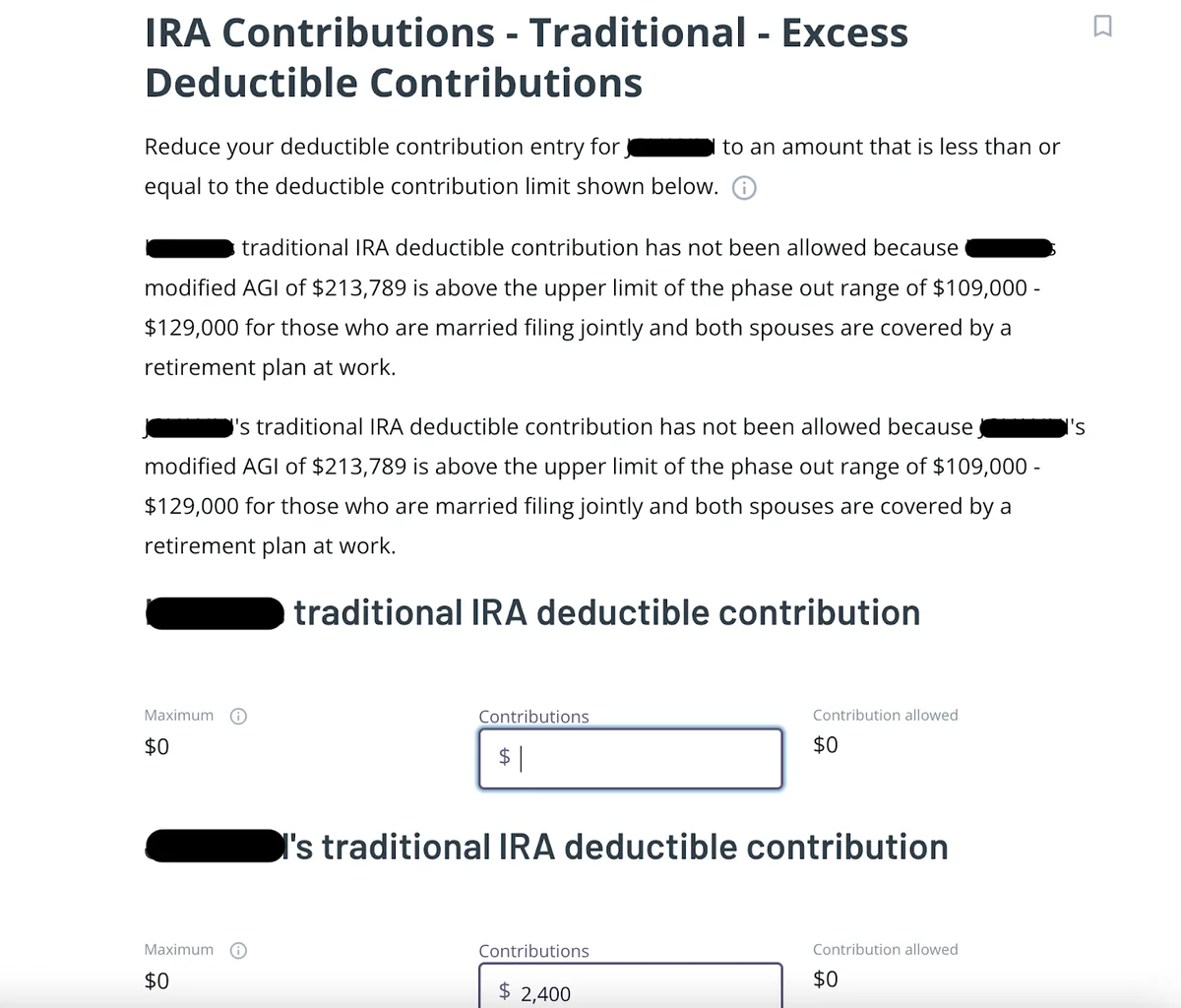
In this screenshot from an earlier year, the software flagged an overcontribution to a Traditional IRA. The couple’s income of $213,789 put them above the deduction limit for both spouses being covered by workplace plans in 2022.
What do you do? File Form 8606. You’re essentially telling the IRS: “Oops — those contributions were actually non-deductible all along.” In one example, a spouse accidentally contributed $2,400 to a Traditional IRA without realizing they couldn’t deduct it. Reclassifying the entire amount as non-deductible dodged the penalty.
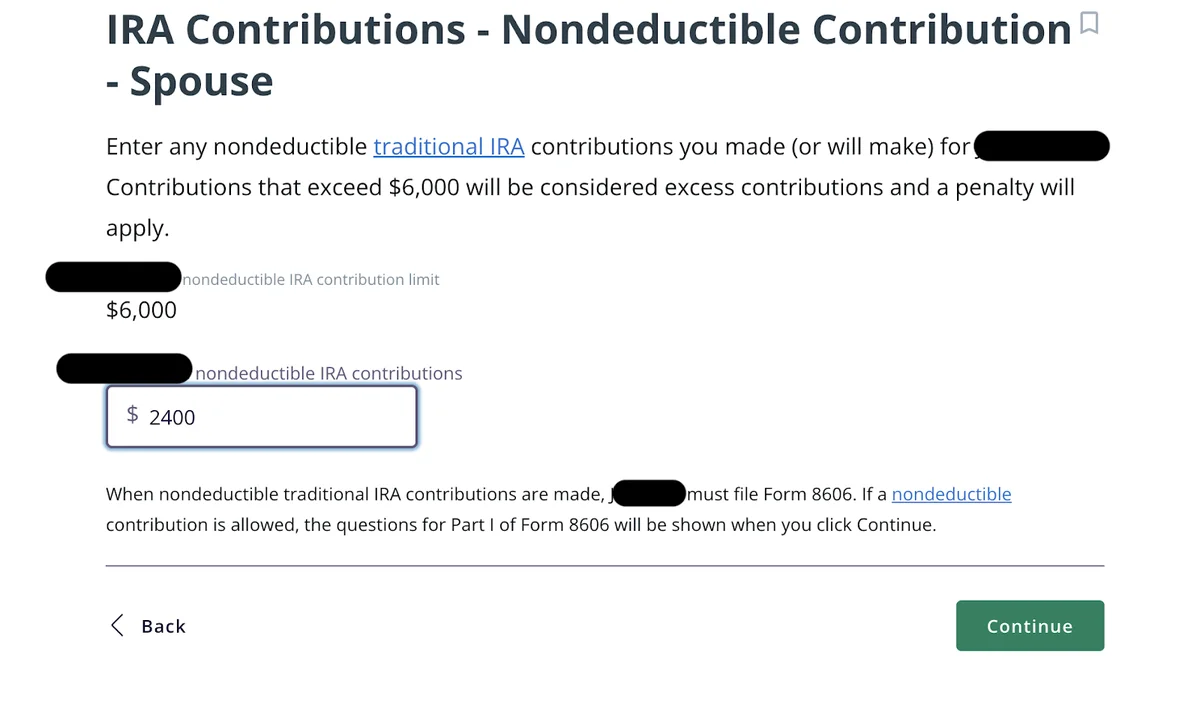
Quick terminology check: “deductible” means you wipe the contribution off your taxable income. Non-deductible contributions still grow tax-sheltered — you just don’t get the upfront deduction.
Then there’s the 1099-R. If you rolled over a 401(k) into an IRA, your investment firm sends you this form for any distribution from a retirement account — even a perfectly normal rollover. The first time I got one, I was convinced I had done something wrong and the Pentagon now had me on their list.
The form shows three things: the rollover amount, the code identifying it as a rollover, and the taxable amount (which should be $0.00 if nothing changed tax status). It does not impact your bill — but you still need to report it. The IRS is serious about transparency.

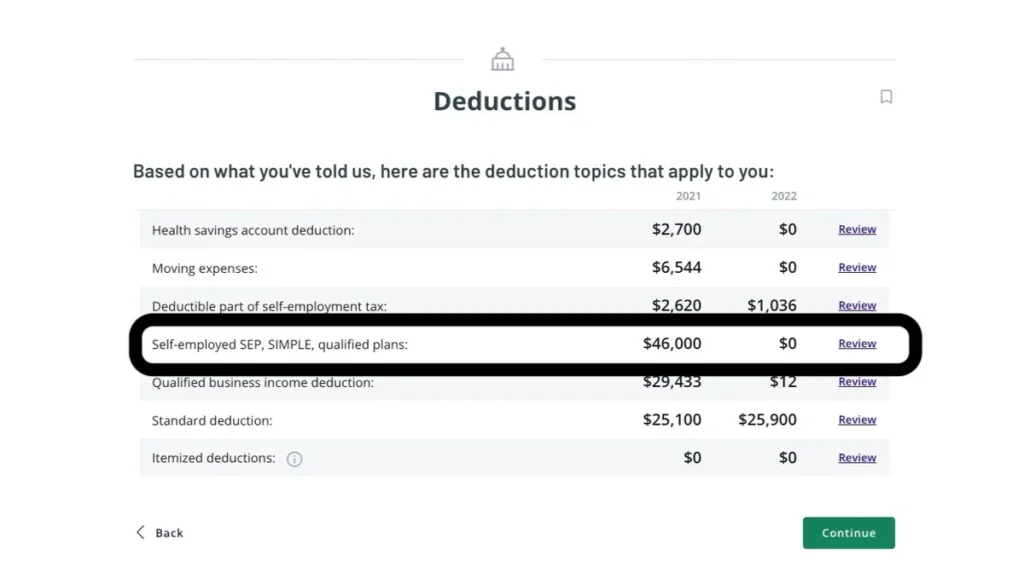
The SEP IRA — a last-minute option for side hustlers
If you have any self-employment income (1099 income), a SEP IRA can be a real game-changer. This is especially useful if you’re a solopreneur or run a side business.
Here’s the quick version: you can contribute up to 20% of your net business income, capped at $69,000 for 2024. A tax professional I work with taught me an easy shortcut — instead of dividing by a complicated percentage, just multiply your self-employment income after write-offs by 20%. That gives you a close estimate.
Example: Your business earned $15,000 and you wrote off $3,000 in expenses. Net income is $12,000. Multiply by 20% — you can contribute around $2,400 to your SEP IRA.
The reason the SEP IRA shines for retroactive tax planning: you don’t need to open it until April 2025 and still fund it for 2024. A Solo 401(k), by contrast, must be opened by December 31, 2024, to count for that year.
One caveat — if you do a Backdoor Roth IRA because your income exceeds the Roth limit, adding a SEP IRA complicates things since it counts as a pre-tax IRA. A workaround: open both a SEP IRA and a Solo 401(k), fund the SEP for 2024, then roll it into the Solo 401(k) after filing. Your SEP balance goes to $0, and your Backdoor Roth path is clear again.
The HSA — triple tax-advantaged
If you have a high-deductible health plan as defined by the IRS, an HSA might be your best friend this season. Contributions grow tax-free forever if used for qualified medical expenses.
For 2024, the minimum annual deductible to qualify is $1,600 for individual coverage and $3,200 for family coverage. Contribution limits are $4,150 for self-only plans and $8,350 for family plans.
Once your HSA has roughly $1,000 to $2,000 in cash (varies by plan), you can usually start investing the funds through your HSA provider’s portal. I try not to let money sit idle — even inside an HSA.
There is a small catch: direct contributions (not payroll deductions) are subject to FICA tax, while payroll deductions aren’t. That’s another 7.65% you save by routing through your employer going forward. But for retroactive 2024 contributions made in 2025, a lump-sum direct contribution is perfectly fine.
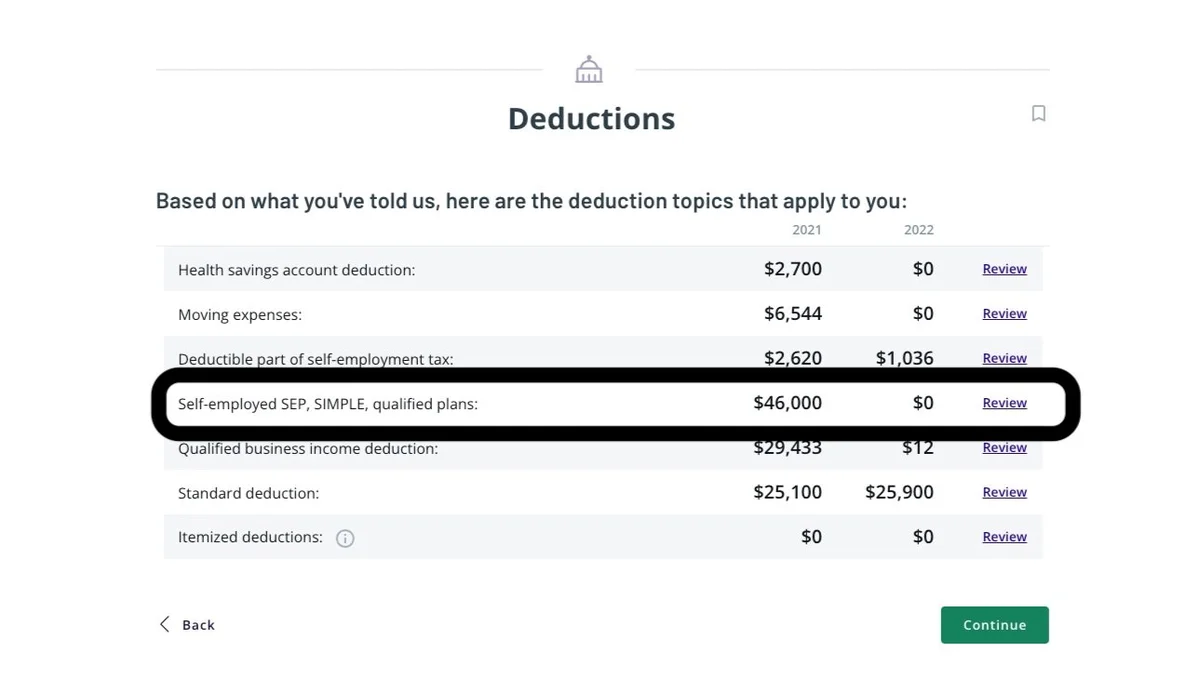
The HSA is unique because it never faces required minimum distributions. If you hold onto it until age 65, withdrawals for non-medical expenses are taxed like a Traditional IRA — but without any forced distribution schedule. It’s essentially a second retirement account that nobody can make you touch.
Could all three work for you?
If you’re not covered by a workplace retirement plan, have side-hustle income, and carry a high-deductible health plan, you could theoretically use all three strategies in the same year. That’s a serious dent in your tax bill.
Of course, I’m not a licensed tax professional — these are observations from someone who has spent enough hours staring at IRS forms to know when to ask a CPA for help. Every situation is different. Run your numbers first, then decide which of these levers makes sense for you.
The simplest next step: log into one retirement account today and check your year-to-date contribution. If there’s room left, mark April 15 on your calendar as the deadline to make a retroactive move.