
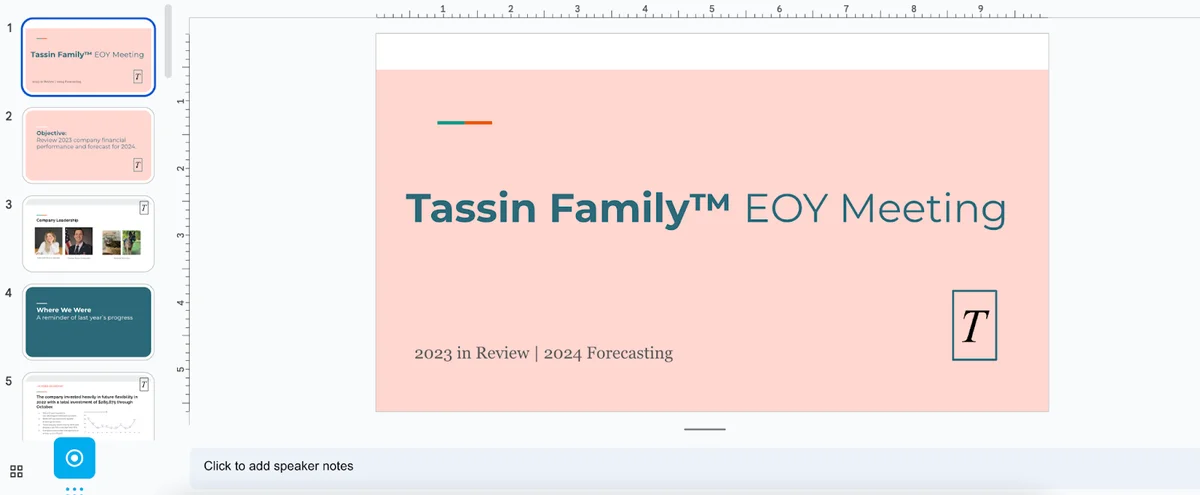
Last December, I did something that felt equal parts productive and ridiculous: I put together a slide deck of our entire year’s finances, AirPlayed it onto the living room TV, and asked my husband to watch it.
He looked at me like I had just requested a performance review from him. “Wait,” he said. “Do I actually have to pay attention?” He was right to ask — but trust me, it was worth the 26 pages.
I fill out our Wealth Planner every month anyway, so I figured presenting all this data to someone else wouldn’t reveal much new. But as Nick Saban says: trust the process. And it did. Here is what our annual review showed us.
The difference a bull market makes
One slide from last year’s report still stings. In 2022, for every dollar we contributed to our assets, our net worth grew by just 67 cents. It felt like every dollar we dumped into the pile caught fire and lost 33 percent of its value.
Our whole portfolio was getting incinerated in the worst bear market since 08, and our new contributions made up only about a quarter of our total net worth. Not exactly an encouraging environment for saving. But we stayed the course.
In 2023, the S&P 500 returned an astonishing 24 percent (as of this writing). Our overall assets grew by 51 percent — three times the growth we saw in 2022. Of that growth, 66 percent came from our contributions and 33 percent was purely the market going up.
Seeing back-to-back years with wildly different outcomes is a little disorienting. But my feedback to the animal spirits: I much prefer this year’s vibe, thanks.
The takeaway: Sticking to your investment plan — whether you’re seeing red or green in the markets — has always paid off. Past performance is not indicative of future returns, but you knew that already.
When your budget looks perfect on paper, your bad habits just go underground
Here is where I need to get honest. When it comes to the things I actually had control over — my spending — the grade was decidedly less glowing.
We spent a total of $157,190 in 2023. I know what you’re thinking. But hear me out. We were having a good time.
By “having a good time” I mean:
- Moving our entire life 1,000 miles west to California
- Paying for multiple surgeries and procedures for our dog with bone cancer
- Going to see Taylor Swift — the concert, then the movie, then the movie again
- Buying a Porsche Macan (understandably the biggest single item)
We also traveled to Vail, Dallas, London and Edinburgh, Los Angeles, San Francisco, Sacramento, and New York City five times. Plus roughly six other places I cannot remember right now.
Despite all that hoopla, most of our spending plans actually went according to plan. Travel came in only 8 percent over budget — not bad at all. And after mentioning it no less than six times this year: we were really focused on wrangling food spending, and we did. I learned to cook, and our food budget ended up 7 percent under what we planned.
Where things went off the rails was Miscellaneous — which is my catch-all for “Guilt-Free” spending and gifts. This category represented 16 percent of our total spend, and we spent more than double (closer to three times) what we had intended. Taylor Swift, moving cross-country, buying a car — they all lived in that bucket.
Unlike a food or gas budget gone wrong, “Guilt-Free Spending” requires deeper digging. It can only be shrunk by having a little more self-control. I need to relearn how to tell myself no.
The takeaway: The best budget breakthroughs are the kind that leave you staring in the mirror going, “It’s time to find some cheaper hobbies.”
Despite everything, we still beat our savings goal by 13 percent
Not because we were miraculously under-budget elsewhere — we weren’t. But we earned more this year than anticipated.
Our current net worth could support a retirement lifestyle costing $72,000 per year. When I shared that with my husband, he said: “You’re telling me we could quit work forever if we just spent less than $72,000 a year? That’s tempting.” I reminded him that would mean moving somewhere cheaper, traveling far less, and living without a dog or children. He reconsidered.
The most exciting finding: we are on track to become financially independent in approximately three years. Which means — if history repeats itself — I have 36 months to triple our spending again and go, “Oops! Just kidding!”
What’s changing next year
The first change: I am stopping my dinosaur-level guilt-free spending. No luxury vehicle in 2024, and I’m reinstating my fire-and-brimstone budgeting approach. If you’ve spent your allotted amount, you wait until next month.
The second change is a new “Development” category — for things like a writing coach, an online membership to The Class, maybe piano lessons or a Spanish tutor. I haven’t pinned down the exact allotment yet, but part of it may count as a business expense.
I keep telling myself that next year is about leveling up: continuing the good habits from this year and refining them by investing in my professional and personal growth. Because there are two ways to reach a savings goal — and one of them is a little more fun than the other.
Slow and steady wins the race with money, too. Pick one spending category this week and look at it honestly. You might be surprised by what you find.