

My husband slid the June statement across the kitchen table and pointed at the $395 annual fee. Then he pointed at the 25,000-point companion certificate that came with it. “Is that worth it?” he asked.
I said: let’s do the math. That’s what this post is about.

The Atmos Rewards Summit Visa Infinite Credit Card is the premium personal card in the Atmos Rewards program, the combined loyalty program of Alaska and Hawaiian. There are three co-branded Bank of America cards in the lineup, and each has a different job. This one is built for people who want companion travel without paying full price for the second ticket.
Full disclosure: this post contains links to the card. If you apply through a link on this site, the card issuer may pay us a small commission. The opinions here are my own, not the bank’s or the airline’s.
What the card actually gives you
The card comes with two ways to earn Global Companion Awards:
- A 25,000-point Global Companion Award as part of the welcome offer, and again every year on your cardmember anniversary, just for holding the card. No spending required.
- A 100,000-point Global Companion Award when you spend $60,000 on the card in a single anniversary year (that’s 12 months from when you opened the account, not a calendar year).
You can earn both in the same cardmember year. They are separate benefits.
How the companion award works
A Global Companion Award is a certificate that knocks points off the cost of a second passenger’s award ticket. The 25,000-point certificate takes 25,000 points off the companion’s ticket. The 100,000-point certificate takes 100,000 points off. You can’t stack them on one booking.
Here’s the part that matters at the kitchen table: you need two award seats at the same price on the same itinerary. If there’s only one seat left, the certificate doesn’t work. You can top up the certificate with extra points if the companion’s ticket costs more than the certificate covers.
For example, with a 25,000-point certificate:
- If the ticket costs 20,000 points per person, you pay 20,000 for the first passenger and the certificate fully covers the second. No residual value.
- If the ticket costs 50,000 points per person, you pay 50,000 for the first passenger and 25,000 extra for the second to cover the overage.
The cardmember doesn’t have to be one of the travelers. You can use the certificate for your parents, your best friend, or your college roommate who’s always been jealous of my award redemptions. Both passengers still pay taxes and fees, but paying those with the Summit Card waives the $20 per person partner award booking fee.
Where you can use it
This is the part I didn’t expect to like this much. The companion award works on Alaska, Hawaiian, and the full Atmos Rewards partner network, which ranges from Condor to Qatar Airways. You book everything through alaskaair.com, and both passengers need to be booked at the same time. You can’t add the certificate to a booking after the fact.
I’ve redeemed Atmos Rewards points a lot, mostly for short-haul flights on American. The companion certificate makes those redemptions even more useful, because you’re essentially getting the second ticket at a steep discount.

My first redemption, step by step
Let me walk you through what actually happened when I used my first 25,000-point companion certificate, because the process is simpler than I expected.
Step one: I went to the “Discount / companion code” section of my Atmos Rewards account. That takes you to the Wallet section.

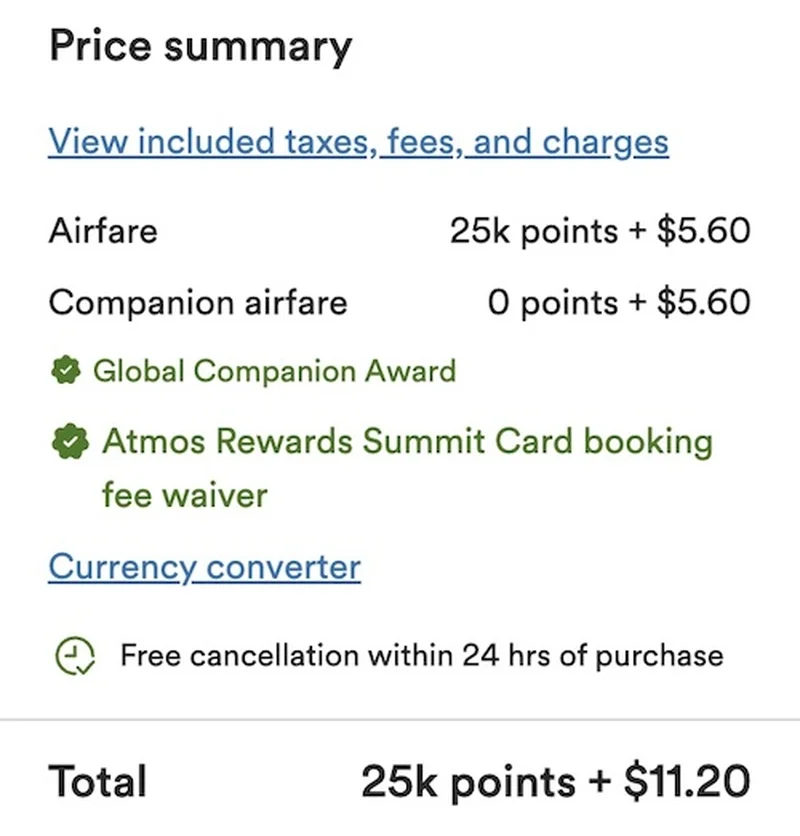
Step two: I found the code labeled “Global Companion Awards Ticket 25K.” I clicked “Use to book,” which took me straight to Alaska’s booking homepage with the code already filled into the discount code box.

Step three: I searched for a first class ticket on American from Miami to Salt Lake City. It costs 25,000 points per person. The search results showed the companion at zero points.

Step four: the confirmation page showed a total of 25,000 points plus taxes and fees for both passengers. On the final booking page, I noticed the ticket had to be purchased with the Summit Card. The initial price showed $26 per person, which dropped to $5.60 once the $20 per person partner booking fee was waived.

That’s the whole process. No phone call. No customer service hold music. Both passengers earn status points on award flights, because the companion is treated like any other award passenger. I’ve shared screenshots of each step so you can see exactly what to expect before you book your own.
The 100,000-point certificate works the same way. I tested it with a roundtrip business class ticket on American between New York (JFK) and Madrid (MAD), which costs 110,000 points per person. With the companion certificate, the second passenger’s cost dropped to 10,000 points.
Does the 25,000 certificate cover the $395 fee?
This is the question my husband actually asked, so let’s answer it honestly.
I value Atmos Rewards points at 1.5 cents each. That puts the 25,000-point certificate at roughly $375 in raw value, before any discount for reduced flexibility. I travel with a companion on an Alaska award at least once a year, and that redemption usually runs 25,000 points per person or more. So for me, the certificate comes in very close to the full $395 annual fee, if not slightly above it.
Add in the waived $20 partner booking fees and the free points sharing benefit, and the card is essentially breakeven just from being a cardmember. That says nothing about the lounge access, the free checked bag, or the purchase protection, which are all real perks I use.
If you travel alone most of the time, the certificate is worth less to you. That’s honest math, not a sales pitch.
Is spending $60,000 worth the 100,000 certificate?
This is where it gets more complicated, and I want to be careful with the numbers.
The 100,000-point certificate is worth up to $1,500 at my 1.5-cent valuation, but I’d discount it. You have to book within 12 months, you need two seats at the same price, and you need an expensive enough award to make it worthwhile. I’d put it closer to half of face value in my own mental accounting, so around $750. Still meaningful, but not the headline number.
Here’s what I think about the spending side. If you’re putting $60,000 on the card, you’re not just earning the companion certificate. You’re also earning:
- One status point for every $2 spent, so $60,000 in spending earns 30,000 status points, which goes a long way toward elite status
- Redeemable points at either 1x or 3x depending on the category. The card earns 3x on foreign purchases, dining, and Alaska and Hawaiian flights, and 1x on everything else
The math matters here. If your $60,000 is all in 1x categories, you earn 60,000 redeemable points plus 30,000 status points plus the 100,000-point certificate. If your $60,000 is all in 3x categories, you earn 180,000 redeemable points plus 30,000 status points plus the certificate. That’s a huge difference, and it’s the reason I think the card is structured to keep you spending on it.
But I’ll be straight with you: if you can’t comfortably put $60,000 on the card, don’t force it. The 25,000 certificate alone carries the card for me, and the 100,000 one is a bonus, not a requirement.
What I’d tell a friend
The companion award is the heart of this card, and it’s more useful than I expected before I actually used it. The 25,000 certificate is close enough to the annual fee that the card pays for itself for anyone who travels with a companion regularly. The 100,000 certificate is a genuine bonus for high spenders, but it needs a realistic plan to actually use it.
If you’re on the fence, here’s what I’d do today: check your own spending and see whether you can get to $60,000 in a cardmember year without forcing purchases. If you can, the card is a no-brainer. If you can’t, the 25,000 certificate and the card’s everyday perks still make it worth a serious look.
Slow and steady. A good credit card strategy is built one statement at a time, and this one does the math for you.