

I was going through our June statement last month when my husband glanced over and said, “So what exactly is a bond ladder?” I told him it’s like setting up automatic bill payments for your future self — each rung matures on schedule so you always know when cash arrives. He nodded like that made sense, which means either he understood or he was being polite.
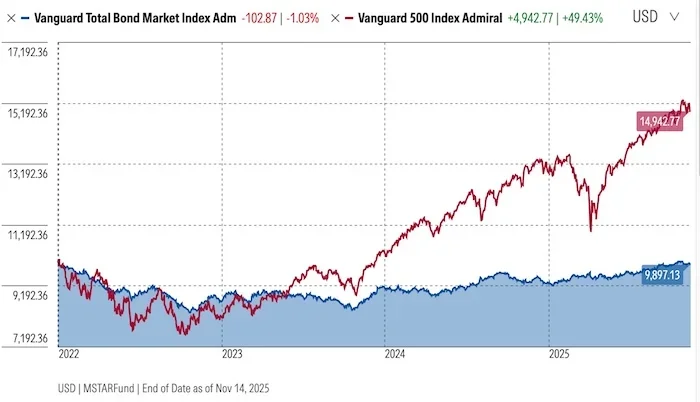
The truth is, after 2022, a lot of people started asking about bond ladders. Bond funds had their worst calendar-year return in several decades that year — down 13 percent for the broad market index, while the S&P 500 fell 18 percent. And as of mid-November 2025, bonds still hadn’t fully recovered those losses. Stocks, meanwhile, were up nearly 50 percent from their bottom.

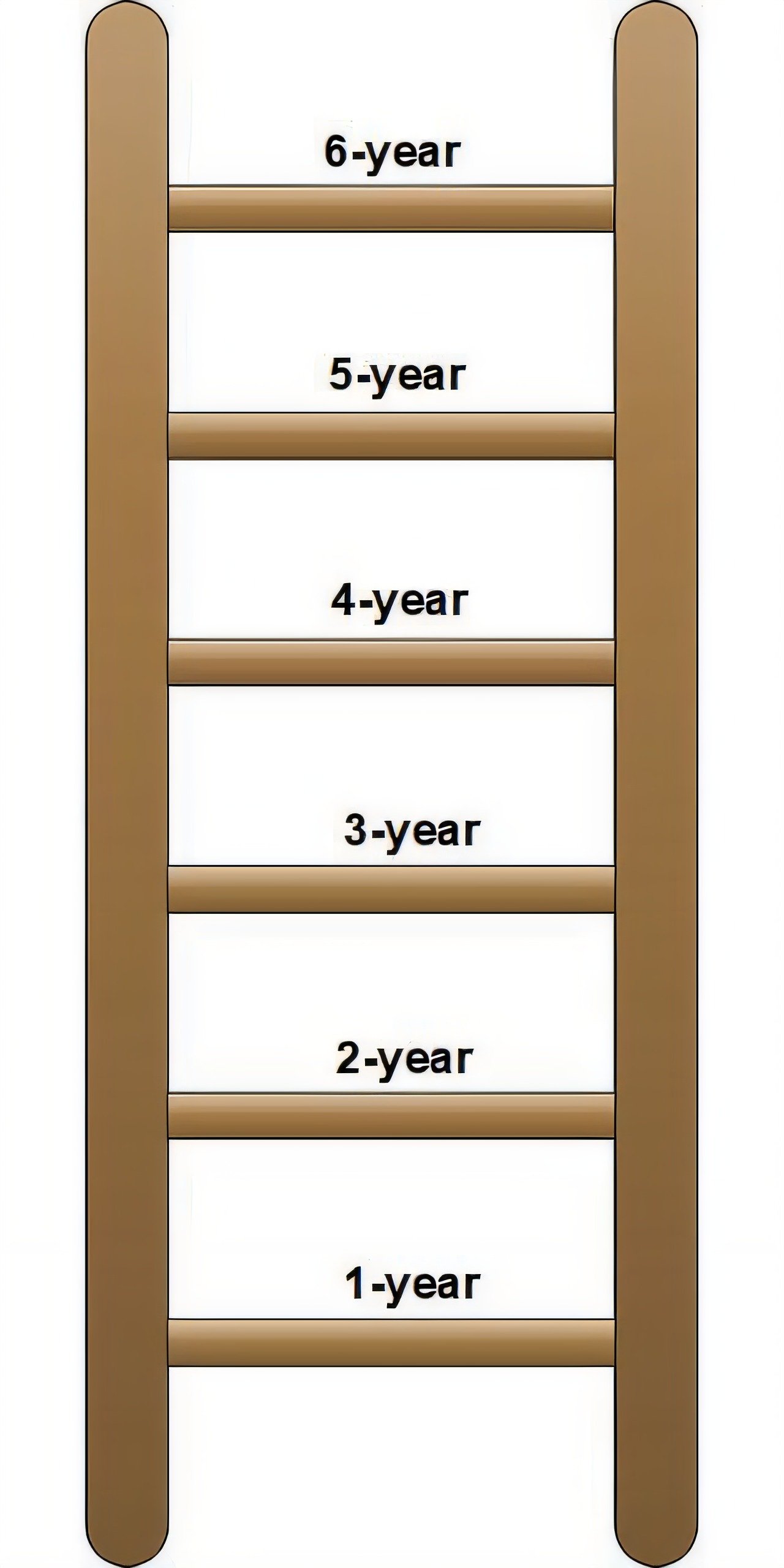
The idea behind a bond ladder is simple: instead of lumping everything into one fund that rides interest-rate swings, you spread your money across bonds maturing in different years. Each year, one rung matures and hands back your principal. You can spend it or roll it into a new long-end bond.
Building one isn’t as hard as it sounds. The difficulty depends on which type of bond you choose. Let me walk through the options — from easiest to most nuanced.
Treasuries: the simplest ladder
You can buy Treasuries at major brokers like Vanguard, Fidelity, and Charles Schwab with no fee. New issues come in weekly batches for shorter maturities (4-week through 26-week) and monthly batches for longer ones (1-year through 30-year). There’s no 4-year or 6-year new issue, but you can fill those gaps on the secondary market.
If picking individual Treasuries feels like too much work, iShares offers iBonds Term Treasury ETFs. Each one holds Treasuries maturing in a single year. The 2028 fund, for example, holds bonds maturing between January and November 2028, then liquidates and pays out cash in December. iShares covers the current year through the next 10 years, so you’d buy one ETF per year to build your ladder.
The expense ratio is 0.07 percent. Individual Treasuries trade in $1,000 increments — these ETFs are about $25 per share, so you can build a more granular ladder with smaller amounts. They also simplify tax reporting if you hold them in a taxable account.
TIPS: inflation protection on a schedule
TIPS are Treasuries adjusted for inflation. You can buy them the same way as regular Treasuries, though there are fewer new issues — most purchases happen on the secondary market. There’s currently no TIPS maturing between 2036 and 2039, but that gap will close in the next few years.
iShares also has iBonds Term TIPS ETFs that work identically to their Treasury counterparts. Each fund holds TIPS maturing within one calendar year, then liquidates. The expense ratio is 0.1 percent, and they cover 10 years forward from the current year.
Brokered CDs: convenient but not a standout
You could build a CD ladder by opening accounts at multiple banks to chase the best rates for each maturity. It’s easier with brokered CDs in a brokerage account, but watch out for callable CDs — those can get yanked away from you when rates fall.
Non-callable CD rates aren’t that much better than Treasuries, and CDs lack the state and local tax exemptions that Treasuries offer. In most cases, I’d go with Treasuries instead.
Corporate bonds: ETFs make sense here
Investment-grade corporate bonds yield more than comparable Treasuries because they carry higher risk. There are no state or local tax exemptions in a taxable account.
Diversifying across individual corporate bonds is difficult unless you have serious capital, so I’d use ETFs for this part of the ladder. iShares offers iBonds Term Corporate ETFs at 0.1 percent. Invesco has BulletShares Corporate Bond ETFs, also at 0.1 percent. Both series cover 10 years forward, and each fund liquidates in December of its designated year.
Vanguard launched a similar corporate bond ETF series in March 2026 with an even lower expense ratio of 0.08 percent.
Municipal bonds: great for taxable accounts
Muni bond ladders follow the same pattern — ETFs are much easier than trying to diversify across individual municipal issuers. iShares offers Term Muni Bond ETFs covering the current year through 6 years out, while Invesco’s BulletShares Municipal Bond ETFs cover 10 years.
Each fund holds over 1,000 muni bonds from different municipalities, all maturing in the designated year. The expense ratio sits at 0.18 percent for both series.
Here’s the thing: muni bond yields are lower than taxable bond yields, so that 0.18 percent fee takes a bigger bite out of your returns compared to the leaner 0.07 and 0.10 percent ratios on Treasury and corporate ETFs. If I were building a ladder with these products, I’d start with Treasury or TIPS funds in a pre-tax account before considering munis.
Rolling ladder ETFs: neat idea, limited appeal
iShares offers four rolling ladder ETFs — one each for Treasuries (LDRT), TIPS (LDRI), investment-grade corporate bonds (LDRC), and high-yield bonds (LDRH). Take LDRT: it invests one-fifth of its assets in each of the 2026 through 2030 Term Treasury ETFs. When the 2026 fund liquidates, that money rolls into a 2031 position.
The concept is tidy, but honestly, you could achieve something similar with a standard short-term bond fund or a broad bond ETF. The market seems to agree — LDRT has $21 million in assets, while the regular short-term Treasury ETF SHY is about 1,000 times larger at $24 billion.
Distributing ladder ETFs: my favorite design
Northern Trust launched what I think is the cleverest product here. Instead of buying 10 separate ETFs for a 10-year ladder, you buy one fund that holds the entire ladder inside and distributes both interest income and maturing principal back to you.
For example, Northern Trust 2035 Inflation-Linked Distributing Ladder ETF (TIPB) holds 10 TIPS — one maturing each year from 2026 through 2035. It pays out the interest earned plus the principal from whatever bond matures that year. The expense ratio is 0.1 percent.
These funds only launched in August 2025, so they’re still small — about $5 million each as of mid-November 2025. I hope they gain traction; otherwise, they face the real risk of not surviving ETF market competition. But the design is solid.
Should you build one?
A ladder makes sense when you need to spend a set amount on a predictable schedule — tuition, a down payment, retirement income. I don’t hold one myself because my spending doesn’t follow that pattern.
But psychological comfort matters. If knowing exactly when your money matures helps you sleep at night, build the ladder. Treasuries and TIPS are straightforward to construct individually or with iShares ETFs. Corporate and muni ladders are easier through ETFs. And if Northern Trust’s distributing ladder funds catch on, it’ll be even simpler.
Start small — pick a 3-year ladder, buy your first three rungs this week, and see how it feels.