
We were at the kitchen table with the June statement when my husband said it. “So the plan is… you just take a little money out every month, right?”
Right. That’s what every fund company will tell you. Invest in your 30s. Switch to monthly withdrawals at 60. Done. It’s a neat narrative, and it sells products. And it’s dangerously incomplete.
A systematic withdrawal plan — an SWP, where your fund automatically redeems a fixed dollar amount every month — is a tool. It’s the wrench in the drawer. The wrench isn’t the house.
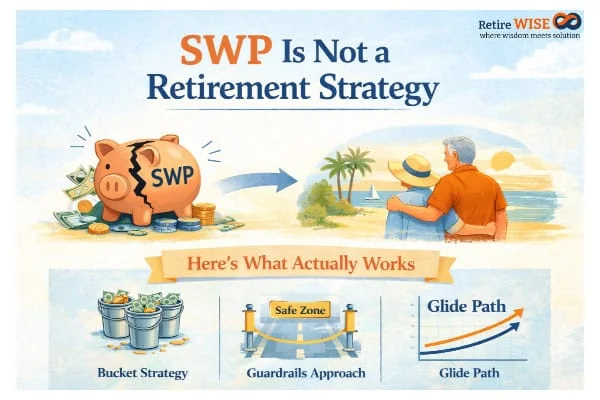
My planner and I have been through this with a lot of families, and I can tell you: the people who leaned on an SWP alone are the same people who called us in a panic during the 2020 crash, the 2022 correction, and the 2008 meltdown. Not because the SWP was bad. Because an SWP without a withdrawal strategy is like driving a car without brakes. It works beautifully on a straight road. On a mountain pass, it kills.
Have you ever asked your advisor how the order of market returns — not the average — will affect your withdrawals in the first five years of retirement? If the answer was a blank stare, keep reading.
What they don’t put on the slide
Walk into any retirement presentation and the deck is predictable: invest a fixed amount every month for 25 years, build a big number, then withdraw a fixed amount every month and live happily ever after.
They don’t show you what happens if the market falls 40% in your first year of retirement — like it did in 2008. They don’t show your portfolio dropping to 60% of what it was while you’re still withdrawing the same amount every month. They don’t show that you’re now selling shares at rock-bottom prices — and those shares are gone, never to recover.
They don’t show that by year 5, your savings are permanently damaged, and no subsequent bull run can fully repair it.
This has a name: sequence of returns risk. It’s the single most dangerous threat to anyone using monthly withdrawals as their only income source.
Sequence risk, in a bucket of water
Picture your retirement savings as a bucket of water with a hole in the bottom. Water drains out every month — your withdrawals. Rain falls in periodically — market returns. If the rain comes early and heavy, the bucket stays full. If there’s a drought in the first few years while the water keeps draining, the bucket empties. And no amount of rain after that refills it.
Here’s the math that keeps me up at night. Two retirees, same day, same portfolio, same withdrawals.
Good years first. Meera (name changed) retires with ₹2 crore. Markets return +15%, +12%, +8% in years 1–3. She withdraws ₹1 lakh a month. After three years, her savings have grown to ₹2.4 crore — despite the withdrawals. She’s safe.
Bad years first. Deepak (name changed) retires the same day with the same ₹2 crore. Same ₹1 lakh a month. But his market sequence is -20%, -8%, +5%. After three years, his savings are ₹1.35 crore. He’s withdrawn ₹36 lakh and lost ₹65 lakh to the bad sequence. His portfolio is permanently 44% smaller than Meera’s.
Same average return over 20 years. Same withdrawal. Same fund. The only difference: the order in which returns arrived.
This isn’t theoretical. Equity markets have delivered -52% (2008), -38% (2020, briefly), and -23% (2022). If any of those hits in your first three years of withdrawals, you’re Deepak.
The hard truth about the wrench
An SWP redeems a fixed dollar amount every month. In a falling market, that means selling more shares to generate the same income. Those extra shares are gone forever. That’s why the first five years of retirement are the most dangerous window for any withdrawal plan. Your entire retirement outcome can be decided by what the market does in those five years — not the next 25.
No slide deck shows you this. Because if it did, “invest in, withdraw out” would look a lot less like a strategy and a lot more like a gamble.
Strategy 1: The bucket strategy — your crash shield
The bucket strategy is the answer to sequence risk, and it’s elegantly simple: split your retirement savings into three time-based buckets, so you never have to sell investments in a falling market.
Bucket 1 — the next 0–3 years. ₹36–45 lakh. This is your sleep-well money. Parked in a ladder of fixed deposits, a money-market fund, and a savings account. It covers three years of expenses no matter what the market does. When the index drops from 80,000 to 50,000, you don’t care — next month’s ₹1.2 lakh comes from this bucket, not from your investments.
Bucket 2 — the next 3–7 years. ₹50–60 lakh. Guaranteed-income vehicles: India’s Senior Citizen Savings Scheme (a government-backed senior savings plan, 8.2% guaranteed, max ₹30 lakh), the Post Office Monthly Income Scheme (7.4%, max ₹9 lakh individual / ₹15 lakh joint), short-term bond funds, and conservative hybrid funds. This bridges safety and growth. As Bucket 1 runs low, you refill it from Bucket 2 — but only when bond markets are calm, not during a crisis.
Bucket 3 — 7+ years out. ₹80 lakh to ₹1.2 crore. This is where the SWP lives — and the only bucket where an SWP belongs. Equity hybrid funds, balanced funds, or a diversified stock portfolio. This money has a 7+ year horizon, so it can survive one or two crashes and still come out ahead. You draw from it to refill Buckets 1 and 2 — but only when markets are up, never when they’re down.
Here’s the blueprint for a ₹2 crore portfolio:
| Bucket | Allocation | Where it sits | Monthly income |
|---|---|---|---|
| Bucket 1 (0–3 yrs) | ₹40 lakh | FD ladder + money-market fund | ₹1.1 lakh (draw-down) |
| Bucket 2 (3–7 yrs) | ₹55 lakh | SCSS ₹30L + POMIS ₹15L + bond fund ₹10L | ~₹30,000 (interest) |
| Bucket 3 (7+ yrs) | ₹1.05 crore | Equity hybrid fund (SWP) | SWP ₹50,000 (when markets are up) |
| Total | ₹2 crore | ~₹80,000–90,000 |
The magic of buckets isn’t financial — it’s psychological. When the market crashes 35%, Deepak (SWP-only) panics and stops his withdrawals, locking in losses. Meera (with buckets) sips her chai and says, “Bucket 1 has me covered for 3 years. I’ll wait.” By the time Bucket 1 runs low, the market has recovered, and she refills it from Bucket 3 at higher values.
The bucket strategy doesn’t give you higher returns. It gives you the ability to stay the course — which, in retirement, is worth more than any extra percentage point.
Strategy 2: Guardrails — spending that adjusts automatically
Guardrails — developed by Jonathan Guyton and William Klinger — solve a different problem: what if your fixed withdrawal is too high in bad years and too low in good years?
Here’s how it works. You start with an initial withdrawal rate — say 5% of your portfolio, which is ₹1 lakh a month on ₹2.4 crore. Then you set two guardrails:
Upper guardrail: if your current withdrawal rate rises 20% above the starting rate (your portfolio has dropped significantly), you cut your withdrawal by 10%.
Lower guardrail: if your current withdrawal rate falls 20% below the starting rate (your portfolio has grown significantly), you increase your withdrawal by 10%.
A real example. Priya (name changed) starts retirement with ₹2 crore. Initial withdrawal: ₹83,000 a month (5% a year). Her guardrails sit at 4% (lower) and 6% (upper).
Year 1: the market crashes. Her portfolio drops to ₹1.5 crore. Her withdrawal rate is now 6.6% (₹83,000 × 12 ÷ ₹1.5 crore). That breaches the 6% upper guardrail. She cuts her withdrawal by 10% to ₹75,000 a month.
Year 3: the market recovers. Her portfolio rises to ₹2.5 crore. Her withdrawal rate falls to 3.6% (₹75,000 × 12 ÷ ₹2.5 crore). That breaches the 4% lower guardrail. She raises her withdrawal by 10% to ₹82,500 a month.
The beauty of guardrails: you can start with a higher initial withdrawal rate (5–5.5% instead of the traditional 4%) because the corrections are automatic. Research from Morningstar found guardrails can support the highest starting safe withdrawal rate — up to 5.2% — because the system self-corrects before your portfolio suffers permanent damage.
The uncomfortable part: guardrails require you to accept that your income will fluctuate. In a bad market, you might cut spending by 10%. For someone with fixed monthly costs — loan payments, health insurance, condo fees — that 10% cut can sting. That’s exactly why guardrails work best combined with the bucket strategy: the guaranteed buckets cover your non-negotiables, while the guardrails-adjusted withdrawal covers discretionary spending.
Strategy 3: A glide path — adjusting risk as you age
As you move through retirement, your relationship with risk changes — and your stock allocation should change with it.
The starting point for most retirees is simple: reduce stock exposure as you age. Early in retirement, a major crash can permanently damage your savings while you’re still drawing from them, and you have less time to recover. Capital preservation matters more. Deeper into retirement, the sequence-risk window closes — but a different risk emerges: inflation quietly eroding your purchasing power over a 20–30 year horizon.
That creates a three-phase framework my planner and I use with families:
Phase 1 — Early retirement (years 1–10): reduce stocks gradually. The priority is protecting your savings during the highest-risk sequence period. Buckets 1 and 2 do the heavy lifting for income; your stocks (Bucket 3) compound undisturbed.
Phase 2 — Mid retirement (years 10–20): keep reducing, then stabilize. By this stage, sequence risk has diminished significantly — you’ve survived the danger zone. Keep trimming stocks, not because you can’t tolerate risk, but because your income needs are increasingly met by guaranteed sources and you need less growth engine.
Phase 3 — Late retirement (20+ years): adjust based on what’s left. This is where the decision becomes personal. If your savings are healthy and ahead of your projected needs, you can afford to hold more stocks to leave a legacy or fund unexpected late-life healthcare. If your savings have depleted faster than expected, you may need to reduce stocks further and shift to guaranteed income. There’s no single answer — this takes a review with your planner.
| Phase | Age | Stocks | Bonds + fixed | Main risk managed |
|---|---|---|---|---|
| Early retirement | 60–70 | 40–50%, reducing | 50–60% | Sequence of returns |
| Mid retirement | 70–80 | 25–35% | 65–75% | Capital preservation + inflation |
| Late retirement | 80+ | 20–40% (depends on savings) | 60–80% | Longevity + legacy vs liquidity |
One honest note. Some academic work — notably from Wade Pfau and Michael Kitces — suggests a “rising equity glide path” may produce better outcomes in certain US simulations: start with low stocks to dodge sequence risk, then add them back to fight inflation in later years. Intellectually interesting, but I don’t recommend it as a default. Those models assume a guaranteed pension floor — like Social Security in the US — that makes the rising path safer. Most people don’t have that guaranteed base. Without it, adding stock exposure into your 70s and 80s means meaningful risk for most. Where a rising or flat allocation makes sense — strong guaranteed income, substantial surplus, specific legacy goals — a good planner will customize. But the default should be reducing stocks as you age, and adjusting late based on what your savings actually look like.
The rest of the income toolkit
The SWP lives in Bucket 3. But what fills Buckets 1 and 2? Here’s the full toolkit, with the numbers I work with:
Senior Citizen Savings Scheme (SCSS). 8.2% guaranteed, government-backed, max ₹30 lakh, quarterly interest, with a Section 80C tax benefit. This is the anchor of Bucket 2. Every eligible retiree should max this out on day one.
Post Office Monthly Income Scheme (POMIS). 7.4% with a monthly payout, max ₹9 lakh individual / ₹15 lakh joint, 5-year lock-in. Combined, SCSS + POMIS delivers about ₹35,000 a month in guaranteed income — enough to cover non-negotiable monthly expenses for many retirees.
An FD ladder. A 5-rung ladder with deposits maturing annually. At 7–7.5% (senior citizen rates), ₹30 lakh in fixed deposits generates about ₹18,000 a month. More importantly, laddered maturities give you annual access to principal without break penalties. This is Bucket 1.
An annuity. Guaranteed lifetime income, but at a 5–6% internal rate of return it barely keeps pace with inflation, and it isn’t inflation-adjusted. A ₹50,000 annuity feels like ₹25,000 in 12 years. Use sparingly — 10–15% of your savings at most — for the absolute floor of guaranteed income.
A National Pension System (NPS) wind-down. Non-government subscribers can withdraw up to 80% as a lump sum (if the corpus is over ₹12 lakh); only 60% is confirmed tax-free under Section 10(12A). The mandatory 20% annuity becomes your guaranteed floor, and the lump sum goes into Buckets 1–3.
Rental income. If you already own property, rental yields of 2–3% in big cities supplement your income. But buying property at retirement specifically for rent? The math rarely works. ₹1 crore in property gives you ₹20,000 a month in rent. The same ₹1 crore in SCSS plus an SWP delivers ₹55,000–60,000 a month. If you own your home but need income, a reverse mortgage is worth a conversation.
How the wrench actually works
Now that we’ve established the SWP is a tool, here’s how the tool works — because you’ll still use it inside Bucket 3.
Every month, the fund redeems units worth your chosen amount (say ₹50,000) and deposits the money to your bank account. It’s an SIP in reverse — the automatic investing plan run backwards.
Tax efficiency (FY 2025-26): only the capital-gains portion of each redemption is taxed — not the full withdrawal. Short-term gains (within 12 months) = 20%. Long-term gains (after 12 months) = 12.5% above the ₹1.25 lakh annual exemption. That’s why you should always start an SWP at least 12 months after investing.
Fund selection — where most people go wrong. An SWP from a small-cap fund is gambling, not planning. An SWP from a pure bond fund barely beats inflation. The sweet spot: an equity hybrid fund with 65–75% in stocks, or a balanced fund that dynamically manages its allocation. Low enough volatility to sleep, enough growth to fight inflation.
Withdrawal rate. Stay between 4–6% a year. At 4%, your savings likely outlive you. At 6%, they survive 25+ years with decent market returns. Above 8%? You’re on borrowed time.
What the history charts show
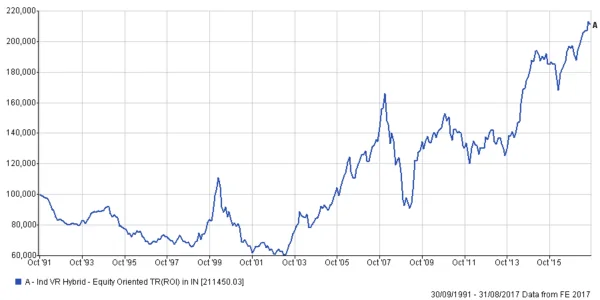
These two charts from a balanced fund category tell the story of SWP’s promise and its peril. First: an 8% withdrawal starting in 1991 (the Harshad Mehta era — India’s first bull market) with ₹1 lakh invested and ₹666 a month withdrawn. The portfolio dropped 40% in the first decade — classic sequence risk. It eventually recovered, but the first 10 years were terrifying. That’s exactly why Bucket 1 exists.
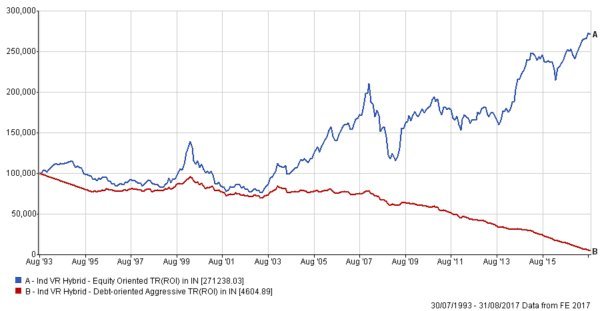
Second: a 10% withdrawal — the danger zone. At that rate, the conservative hybrid fund’s portfolio dropped to nearly zero. This chart should be mandatory viewing for anyone thinking “I’ll just withdraw 8–10% and be fine.”
The five withdrawal mistakes that destroy retirements
1. Treating the SWP as a strategy, not a tool. It tells you how to withdraw. It doesn’t tell you how much, when, or from where. You need buckets + guardrails + a glide path for that.
2. Starting the SWP immediately. Wait 12 months for long-term treatment (12.5% vs 20%). Use Bucket 1 for year one’s expenses.
3. Stopping withdrawals during crashes. If you have a Bucket 1 with three years of safety, you don’t need to stop. But if your entire income comes from one SWP, panic is rational.
4. No annual review. Every year: check your portfolio level, adjust for inflation (raise withdrawals by 5–6%), check whether any guardrail has been breached, rebalance the glide path. One meeting a year can save decades of regret.
5. Believing “invest in + withdraw out = retirement solved.” It’s not solved. It’s started. The building phase is the easy part. The spending phase is where retirements succeed or fail. And the fund industry has zero incentive to make spending complicated — because complicated doesn’t fit on a sales brochure.
Put the three layers together
Here’s the complete system my planner and I use. Not one of these layers works alone. Together, they’re resilient.
Layer 1 — the floor (guaranteed income): SCSS + POMIS + a small annuity. Covers your absolute non-negotiables — medicines, food, utilities, insurance premiums. Even if the market crashes 50% tomorrow, this layer keeps paying. No decisions required. No stomach needed.
Layer 2 — the buffer (crash protection): FD ladder + money-market funds + short-term bonds. Covers 2–3 years of the gap between Layer 1 and your actual expenses. It buys time for your stocks to recover after a crash. This is the layer that prevents panic selling.
Layer 3 — the engine (growth + inflation): an SWP from equity hybrid funds, managed with guardrails and a glide path. This is where the heavy lifting happens — beating inflation over 25–30 years so your ₹75,000 in year 1 keeps its purchasing power (worth ₹1.5 lakh in year 15’s prices). But the engine only works because Layers 1 and 2 protect it from being shut down prematurely.
If you haven’t started planning yet: it’s never too late to start saving, but the later you start, the more your withdrawal strategy matters — because your savings will be smaller and less forgiving of mistakes.
Don’t let one tool carry the whole plan
Bucket strategy + guardrails + a glide path = a system that survives crashes, adjusts to markets, and beats inflation for 30 years.
The fund industry gave you automatic investing for the building phase. For the spending phase — the phase that actually determines whether your retirement works — it gave you a sales pitch called SWP and called it a day. The real strategy is yours to build.
It’s not a numbers game. It’s a mind game. The SWP is just the wrench. The blueprint is buckets, guardrails, and a glide path built for your life.
So tonight, over the June statement at the kitchen table: ask your planner one question — what covers my first three years if the market drops 40%? If they can answer it without looking up, you’re in good hands. If not, start drawing the buckets.