
I sat at our kitchen table last week with a stack of fund statements, and I realized something: every time I thought about stepping out of the market, there was a headline telling me to.
It’s how it always is. The market feels like it needs you to wait. But 46 years of data says otherwise.
The market never stops being volatile — and that’s normal
A friend of mine, let’s call him Akshay, had been watching the markets for four or five years without investing a rupee. Each time he built up the courage, something happened: Russia invaded Ukraine, trade wars restarted, the market wobbled. So he waited.
Here is what 46 years of Sensex data — India’s main stock index, much like the S&P 500 — actually shows about those scary mid-year drops:
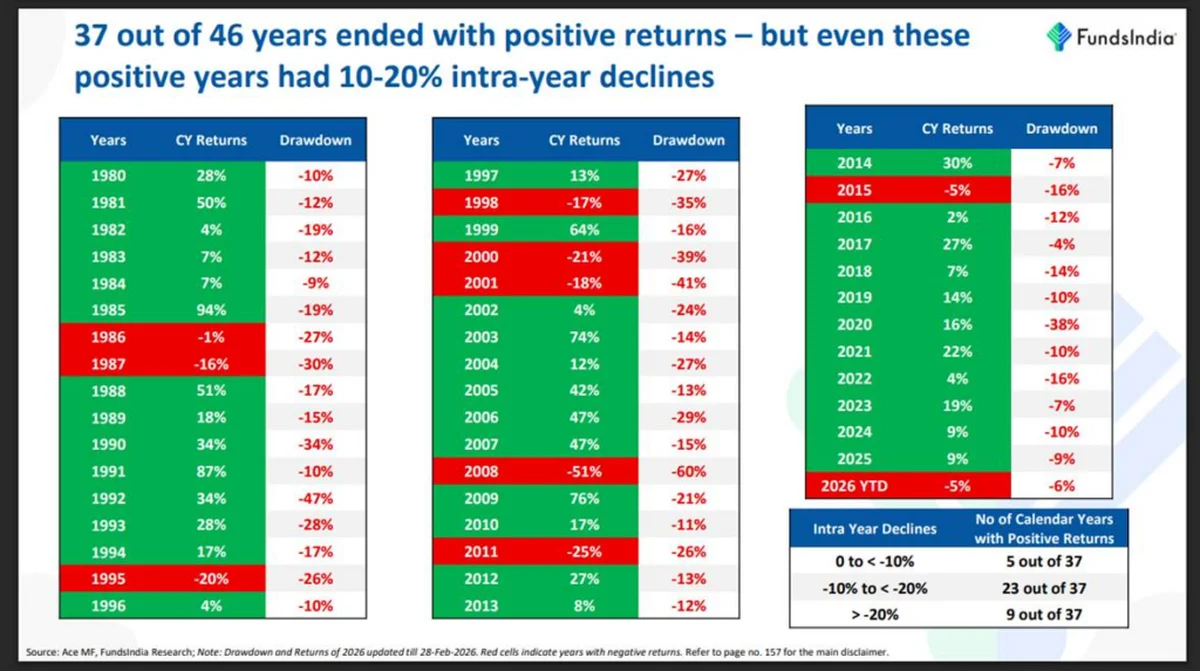
- A 10–20% fall within a single year happens almost every year. The average drawdown over those 46 years is roughly 20 percent.
- 37 out of 46 years — that’s 80 percent — ended with positive returns despite the mid-year pain.
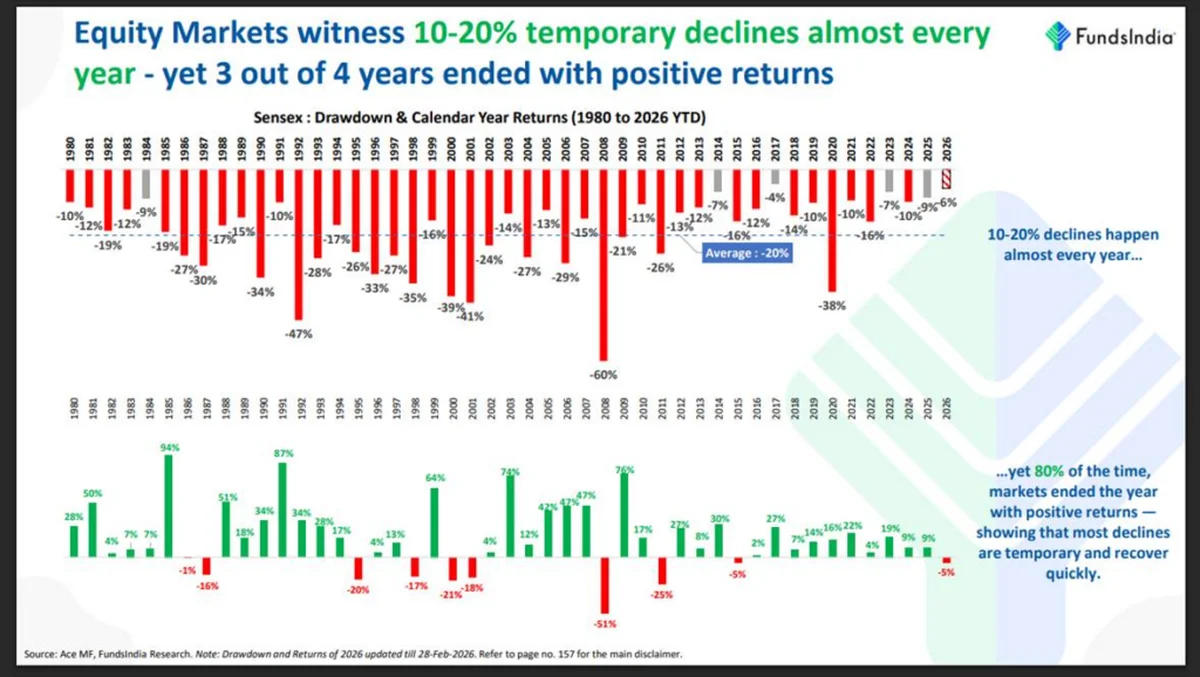
In 1985, the market fell 19% during the year and still ended up 94%. In 2020, a savage 38% crash at the peak of COVID fears gave way to 16% gains by year-end. The falls that feel like disasters turn out to be temporary.
Volatility isn’t a warning sign. For long-term investing, it’s simply the price of admission.
Every major crash recovered — faster than you’d expect
Another friend, Ranbir, started investing about a year ago right in the middle of all this noise. He worries he jumped in at the wrong time. The data has a direct answer.
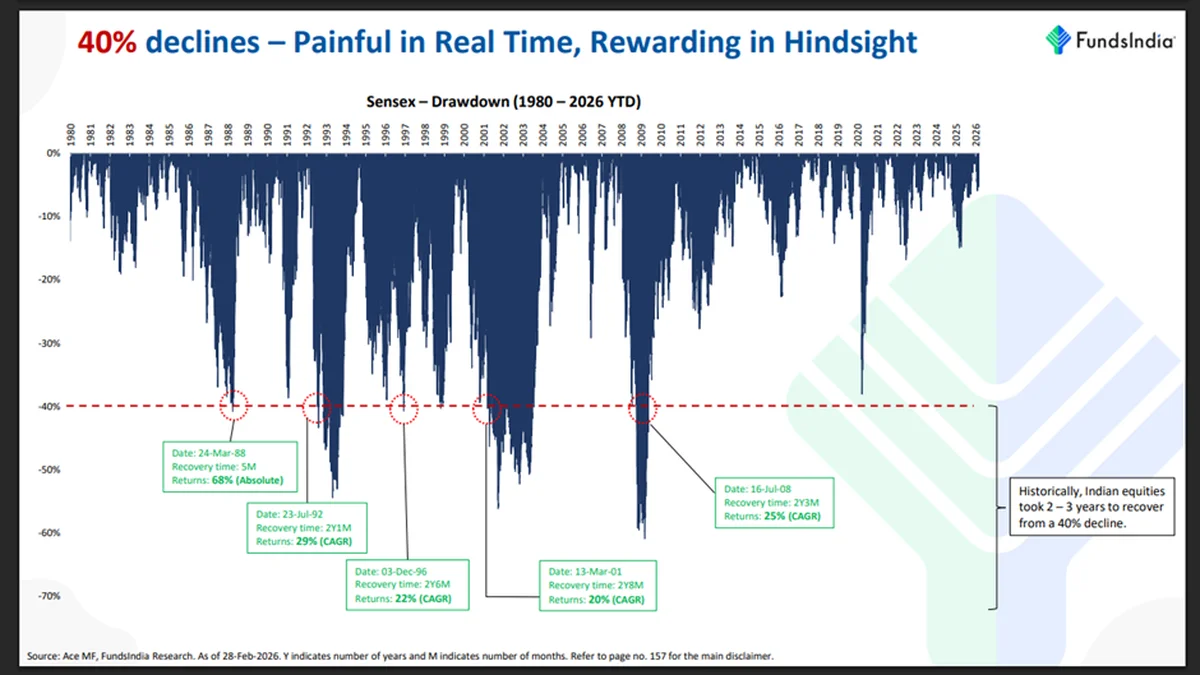
Every decline that exceeded 40% recovered within two to three years:
- The 2008 Global Financial Crisis — nearly a 60% drop — bounced back in about 2 years and 4 months, with 16% CAGR from the bottom.
- The March 2020 COVID crash recovered in just 6 months with 43% absolute returns.
For someone investing over a horizon of seven, ten, or fifteen years, these recoveries aren’t risks. They’re speed bumps.
The news has always been scary — and the market went up anyway
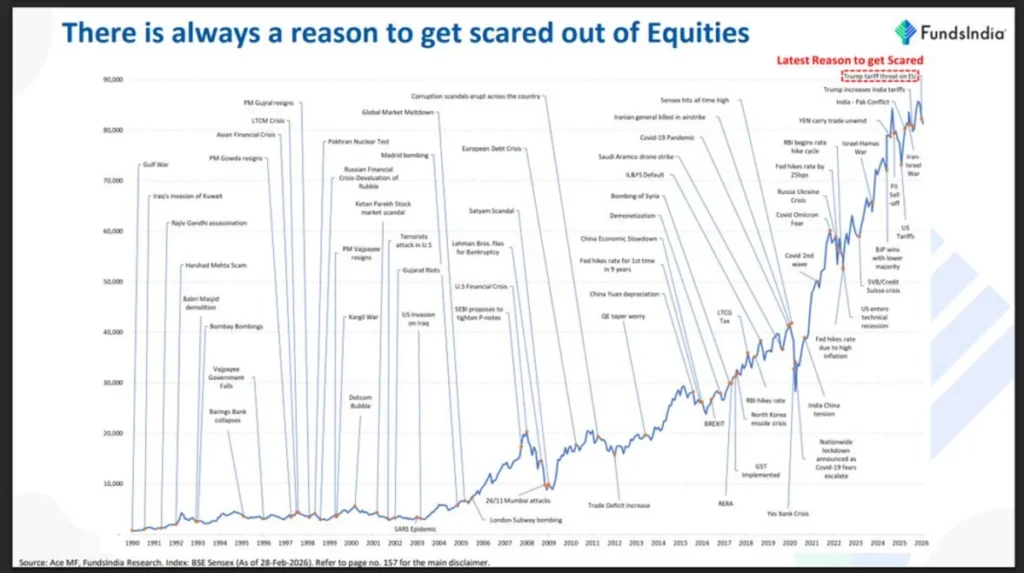
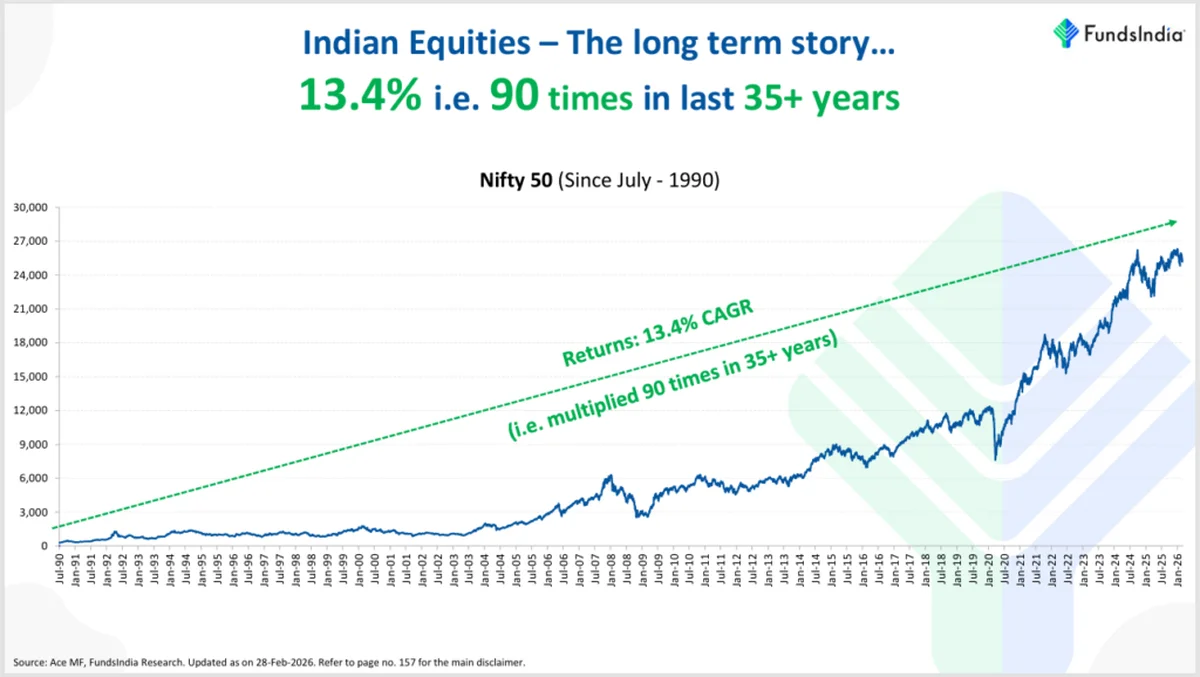
Look at every major crisis from 1990 to 2026: the Gulf War, the Dotcom Bubble, SARS, the Global Financial Crisis, COVID-19, Russia-Ukraine, Fed rate hikes, Israel-Hamas. If you’d waited for the news to turn good before investing, you would have waited forever.
The Sensex went from under 2,000 in 1990 to over 85,000 by 2026. Every single reason to stay out was eventually overcome.
Geopolitics matters in the short term. For long-term investors, it has never determined returns — underlying economic strength does.
The worst entry point still beats not investing at all
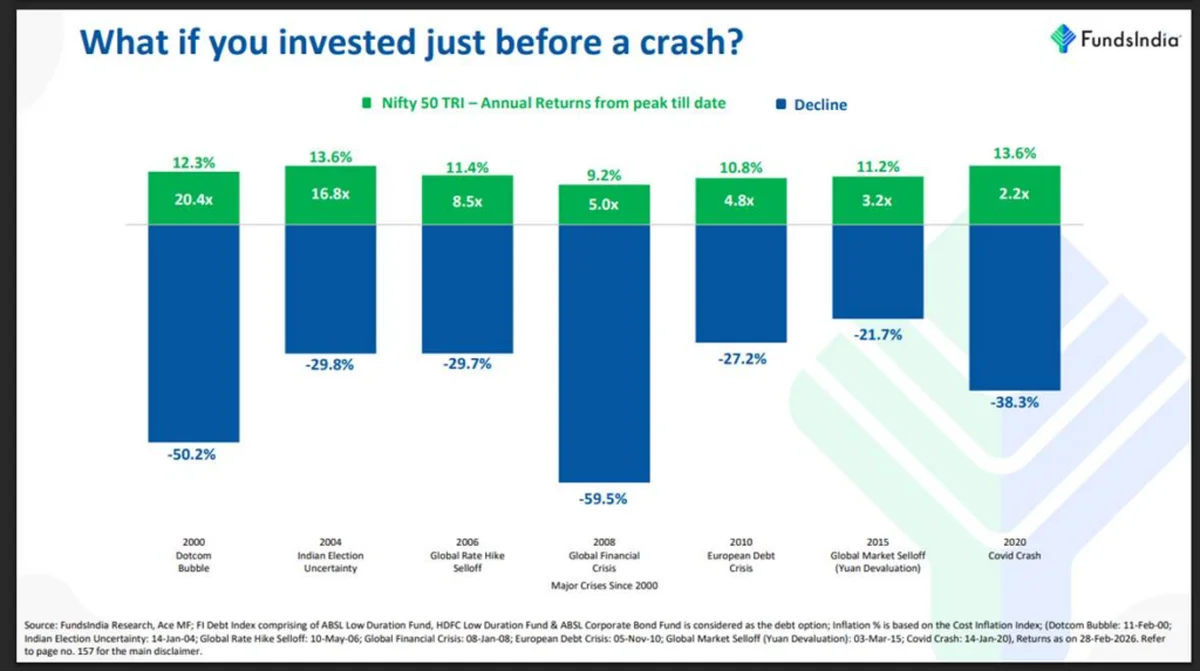
This is the one that convinces me most. If you had invested right before each major crash since 2000, here’s what happened to your money:
- Before the 2000 Dotcom Bubble: grew 20.4x (12.3% CAGR).
- Before the 2008 Global Financial Crisis: grew 5.0x (9.2% CAGR).
- Before the 2020 COVID Crash: grew 2.2x (13.6% CAGR) — in just 5 years.
Not a single scenario resulted in a long-term loss. Yes, there was short-term pain. But every investor who stayed put came out ahead.
Missing just a few best days costs more than you think
This is where the math gets humbling. If you invested Rs. 10 lakh (about $12,000) in July 1999 and stayed invested through every crash through early 2026, your money grew to Rs. 3.03 crore — a 13.6% CAGR.
But if you tried to time the market:
- Miss just the 5 best days: drops 38%, down to Rs. 1.89 crore.
- Miss the 10 best days: down to Rs. 1.37 crore — a 55% reduction.
- Miss the 15 best days: you lose two-thirds of your wealth, at Rs. 1.02 crore.
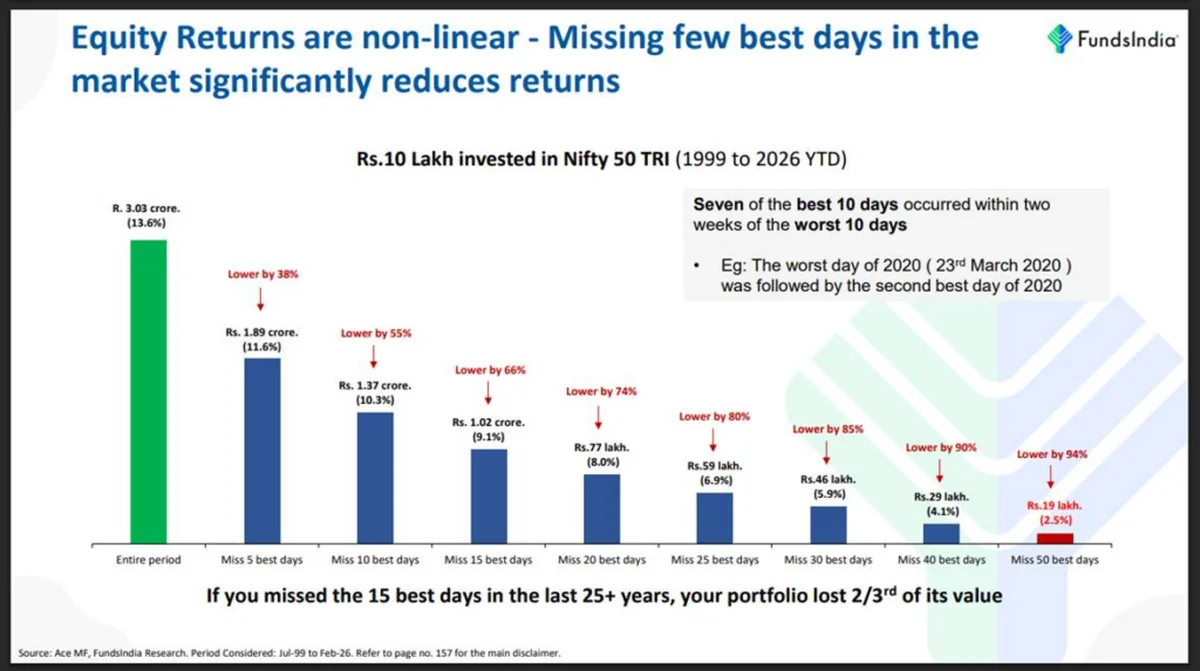
The kicker? Seven of the 10 best trading days occurred within two weeks of the 10 worst. The biggest gains happen right after the biggest falls. So stepping out in fear means almost certainly missing the recovery.
Across every rolling 10-year period from 2000 to 2025, a simple buy-and-hold strategy beat profit-booking strategies in most periods. Whether you booked profits at 20%, 30%, or 50% gains, you almost always ended up with less than someone who just stayed put.
Stop reading the present as a warning
The shift is simple: stop treating today’s headlines as evidence that this time is different. Read the past as evidence instead.
The data isn’t asking you to be fearless. It’s showing you, across 46 years and every crisis imaginable, that fear has never once been the right reason to stop investing.
As Sir John Templeton said: "The four most dangerous words in investing are: ‘This time it’s different.’"
The market will keep scaring you. Open one position this week — even a small one — and let the data do the worrying for you.