
My husband looked at our brokerage statement last month and said, “We own 500 companies now? Since when?” I told him that was the whole point. We didn’t pick any of them. The market did it for us.
I’m not a math person. Numbers used to make me want to hide in the pantry with a spreadsheet and a glass of wine. But once I understood index investing, everything clicked. It turned out the best financial move you can make is also the one that requires the least effort.
Where It All Began: From Dutch Merchants to Your 401(k)
The idea of pooling money to invest goes back further than most people think. In 1774, a Dutch merchant named Adriaan van Ketwich created the first investment trust. Small investors pooled their money to spread risk across plantations and loans instead of betting everything on one ship.
That concept crossed the Atlantic and took root in the US during the 1920s. The Massachusetts Investors Trust launched in 1924 as the first open-end mutual fund, letting ordinary people buy shares at net asset value without needing a Wall Street connection.
The 1929 crash exposed some serious problems—leveraged funds collapsed, and Congress responded with the Investment Company Act of 1940. After that, active management dominated for decades. Fund managers picked stocks promising to beat the market. My husband still believes someone in a suit can time the market perfectly. I stopped arguing about it years ago.
How Index Investing Was Born (and Why Nobody Wanted It)
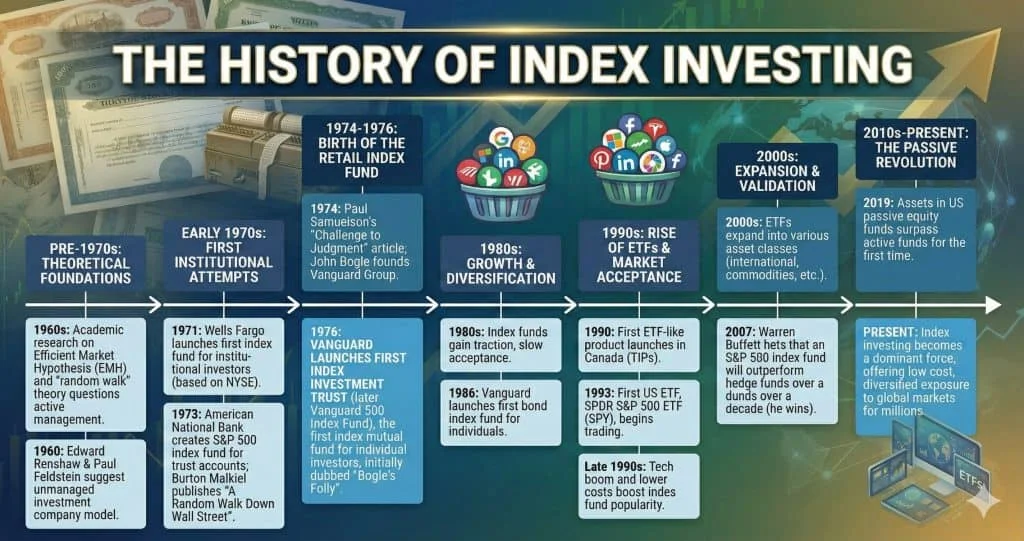
The concept of an index fund started as a paper idea. In 1960, researchers Edward Renshaw and Paul Feldstein proposed an “unmanaged investment company”—a fund that simply mirrored the market instead of trying to outsmart it.
Wall Street laughed. Passive investing sounded like giving up.
The first real index fund launched in 1971, created by Wells Fargo for institutional investors only. It tracked the New York Stock Exchange performance and was mostly ignored by regular people.
Then Jack Bogle entered the picture. After being fired from Wellington Management, he founded Vanguard in 1975 with a simple mission: put investors first. In 1976, he launched the First Index Investment Trust—later renamed the Vanguard 500 Index Fund. It was the first index fund available to everyday investors.
At launch, it raised only $11 million. Critics called Bogle naive. Some called his fund “Bogle’s Folly.” He kept going anyway because he believed low costs and broad diversification were better than any stock picker’s gut feeling.
The Research That Changed Everything
Here’s where the data gets really interesting. The Efficient Market Hypothesis, developed by economist Eugene Fama in the 1960s, suggests that stock prices already reflect all available information. In plain English: it’s nearly impossible for anyone to consistently beat the market after you factor in fees.
Research from S&P Dow Jones Indices shows that over 15-year periods, about 92% of active large-cap fund managers underperform the S&P 500. Ninety-two percent. That number alone changed how I think about money.
Burton Malkiel wrote “A Random Walk Down Wall Street” to argue that stock movements are largely random—so trying to pick winners is basically gambling. Paul Samuelson, a Nobel laureate, wrote in 1974 that most portfolio managers should go out of business because they couldn’t beat a simple index.
Even Benjamin Graham—the father of value investing and Warren Buffett’s mentor—admitted late in life that a low-cost index fund was the best choice for most investors. If Graham said it, I’m listening.
The People Who Made Index Investing Mainstream
Jack Bogle’s philosophy was simple: “Don’t look for the needle in the haystack—just buy the haystack.” He pointed out that even a 1% annual fee can eat up 30% of your returns over 40 years. That math should keep every investor awake at night.
Warren Buffett might seem like an unlikely advocate since he’s famous for active stock picking. But in his 2013 Berkshire Hathaway letter, he instructed that his wife’s inheritance go into a low-cost S&P 500 index fund. For the average person—not him—index funds are the answer.
In 2008, Buffett made a bet against hedge funds: over ten years, a simple S&P 500 index fund would outperform a group of top-performing hedge funds. He won by a wide margin. The boring strategy beat the sophisticated one again.
Index Investing Today: Trillions and Growing
Fast forward to now, and passive investing holds more assets than active management. Index mutual funds and ETFs account for over $13 trillion in total assets. The introduction of ETFs starting with the SPDR S&P 500 ETF in 1993 made index investing even more accessible.
Robo-advisors like Betterment and Wealthfront automate the whole process—they allocate your money to index funds based on your risk tolerance, rebalance automatically, and charge a flat management fee of 0.25%. My friend Sarah uses one of these, and she hasn’t opened her portfolio in six months because it runs itself.
For long-term investors, historical average annual returns for broad stock indices sit around 7-10% after inflation adjustments. That’s not flashy, but compounding makes quiet growth incredibly powerful over decades.
The Three-Fund Portfolio: The Simplest Strategy That Works
One of the cleanest ways to implement index investing is the three-fund portfolio, popularized by the Bogleheads community. Three funds cover everything you need:
- Total US Stock Market Index Fund: Captures large, mid, and small-cap stocks across the entire US market. Examples: Vanguard’s VTSAX or Fidelity’s FSKAX.
- Total International Stock Market Index Fund: Adds global diversification to hedge against US-only risks. Examples: Vanguard’s VXUS or iShares’ IXUS.
- Total Bond Market Index Fund: Provides stability through investment-grade bonds, reducing volatility. Example: Vanguard’s BND.
How you split them depends on your age and comfort with risk. A 30-year-old might go 60% US stocks, 30% international, and 10% bonds. As retirement gets closer, shift more toward bonds. This setup keeps costs under 0.1% annually and needs rebalancing just once a year.
It’s a set-it-and-forget-it strategy. Perfect for busy parents, or anyone who would rather not think about the market every day.
Where to Actually Buy Index Funds
Here are the providers I recommend for low-cost index investing:
Vanguard — The original pioneer. Expense ratios of 0.03%-0.04%. Funds like VTSAX (Total Stock Market) and VOO (S&P 500 ETF). Minimum investment: $0 for ETFs, $3,000 for Admiral shares. I personally use Vanguard, and I’ve never regretted it.
Fidelity — Offers zero-expense-ratio index funds like FZROX for total market exposure. Average expense ratio: 0%-0.015%. No minimum investment to open an account. Great for beginners who want Roth IRA access without fees eating their returns.
Charles Schwab — Similar low-cost options with SWTSX (Total Stock Market) and SCHB ETF. Average expense ratio: 0.02%-0.03%. No minimum investment. Solid choice for building a three-fund portfolio with commission-free trading.
Betterment — A robo-advisor that uses index ETFs like VTI and BND in automated portfolios. Management fee: 0.25% on top of the underlying ETF fees (averaging 0.07%-0.13%). No minimum investment. Good if you want hands-off management.
Wealthfront — Another robo-advisor with similar ETF selections and a 0.25% management fee. Minimum investment: $500. Offers tax-loss harvesting for tech-savvy savers who want optimization without daily oversight.
Frequently Asked Questions
What was the first index fund? Wells Fargo created the first one in 1971 for institutional investors. Jack Bogle’s Vanguard 500 Index Fund in 1976 made it available to everyday retail investors.
Why do index funds outperform active managers? The Efficient Market Hypothesis shows that markets are hard to beat consistently. High fees erode returns—research shows 92% of active large-cap funds underperform the S&P 500 over 15 years.
Who championed index investing? Jack Bogle, Warren Buffett, Burton Malkiel, Paul Samuelson, and Benjamin Graham all advocated for low-cost passive strategies at some point in their careers.
How do I start a three-fund portfolio? Pick one fund each for US stocks, international stocks, and bonds. Allocate based on your age and risk tolerance, then rebalance once a year.
Is index investing good for retirement accounts? Yes—it’s ideal for IRAs and 401(k)s because diversification and low fees maximize long-term compounding without requiring constant attention.
The Bottom Line
Index investing grew from a paper idea nobody wanted into a $13 trillion strategy that outsmarts most professionals. The secret isn’t genius—it’s patience, low costs, and letting the market do what it does best.
Start this week. Open an account at one of these brokerages, pick a total-market index fund, and set up automatic contributions. You don’t need to be smart about money. You just need to start. Your future self will send you a thank-you note—and maybe buy you ice cream.